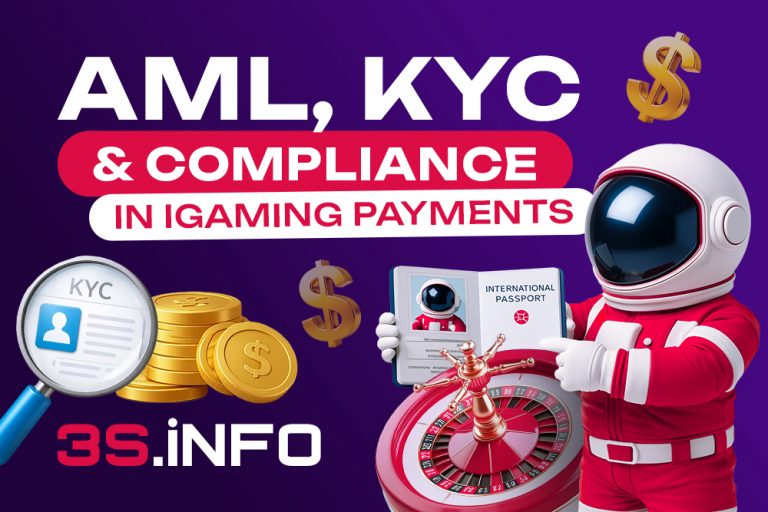

AML, KYC & Compliance in iGaming Payments: How to Avoid Losing Your market & Your PSP

Publication date: 6 April 2026

For regulators and payment providers, iGaming is one of the most toxic high‑risk segments: high turnover, cross‑border transactions, anonymous payments, crypto, aggressive marketing, and elevated risks of addiction. This is precisely why AML, KYC, and payment compliance here are not just “paperwork for a license” but a matter of survival. A single procedural mistake ends in fines, payment blocks, PSP refusals, reputational fraud, and regulatory pressure. Well‑structured AML/KYC processes are the key to accessing payment infrastructure, protecting your license, and driving predictable player LTV growth.

What Do AML, KYC, and Compliance Mean in iGaming?

AML (Anti-Money Laundering) in online gambling is a set of measures designed to prevent money laundering and terrorist financing through casinos, betting, and lottery products. iGaming is considered high‑risk since platforms allow funds to be quickly “run through” deposits, bets, and withdrawals (often across different jurisdictions and currencies).

KYC (Know Your Customer) player verification is the identification and authentication of a person’s identity (documents, address, age, residency) to confirm that the client is real, of legal age, and not subject to sanctions or restrictions. KYC verification of a player in the gambling business includes collecting ID, proof of address, and sometimes biometrics and selfie checks.

Compliance as a system is not just about onboarding procedures, it’s a full cycle: policies and regulations, customer risk assessment, transaction monitoring, case investigation, reporting to the regulator, regular auditing, and staff training.

The key element is the combination of KYC/KYB and source of funds checks:

  • KYC (Know Your Customer) — players: identity, age, country, source of funds (SoF), and source of wealth (SoW) for high‑rollers.
  • KYB (Know Your Business) — B2B clients, affiliates, partners: ownership structure, beneficiaries, licenses, reputation.

Additionally, operators are required to conduct:

  • Sanctions screening: checks against sanctions lists (UN, EU, OFAC, etc.);
  • PEP screening: identification of politically exposed persons (politicians, their families, and close associates);
  • Adverse media screening: searches for negative mentions in the media (fraud, corruption, criminal activity).

All these elements feed into casino anti-money laundering legislation and shape the operator’s AML policy.

Regulatory Framework: Who Regulates AML/KYC in iGaming and How

FATF (Financial Action Task Force) sets the global standards: a risk‑based approach, customer identification, transaction monitoring, suspicious activity reporting, and sanctions for violations. FATF Recommendations apply to banks, PSPs, and operators, including those in online casinos and betting.

MGA (Malta) is one of the key iGaming regulators in the EU. An MGA license requires strict AML policies: appointment of an AML/MLRO officer, KYC/KYB processes, a risk‑based approach, mandatory transaction monitoring, suspicious activity reports, and regular audits. PSPs working with MGA‑licensed operators are subject to enhanced AML control requirements.

UKGC (UK Gambling Commission) is considered the benchmark for a strict AML regime for the UK market. The regulator actively fines operators for weak KYC, lack of SoF/SoW checks, insufficient monitoring of problem gambling and money laundering, as well as poor handling of high‑risk customers.

Curaçao and other offshore jurisdictions have long offered minimal AML requirements, but the trend is moving toward tightening. Nevertheless, many offshore schemes still carry high reputational and payment risks. PSPs and banks view low‑control licenses negatively.

Payment Complexity Level by Jurisdiction

Jurisdiction AML Level KYC Requirements Payment Complexity for the Operator
UK (UKGC) Very high Strict, multi‑tiered Very high
EU (Malta, Sweden) High Stringent, RBA approach High
USA Very high Strict, poker/sports by state Very high
Curaçao Medium / low Basic, operator‑dependent Medium / high (due to PSPs)
Other offshore jurisdictions Low (formal) Minimal High (due to PSP distrust)

Top 5 Strictest Jurisdictions for iGaming Payments

  • UK (UKGC): very strict AML/KYC, tight oversight on payments and players.
  • Sweden: strict limits, self‑exclusion (Spelpaus), responsible gambling, stringent KYC.
  • Germany: complex licensing, restrictions on products and payment methods.
  • Netherlands: high KYC, RG, and payment provider requirements.
  • USA: state‑level fragmentation, comprehensive AML/FinCEN regulation.

Offshore jurisdictions: Curaçao, Anjouan, Isle of Man. Requirements are formally lower, but banks and PSPs increasingly view such jurisdictions as high‑risk, driving up the cost and complexity of integration.

Gray zones: jurisdictions where formal AML is minimal, but reputational risks are maximal. PSPs and banks may refuse service or sharply increase fees.

Learn more: Which Jurisdictions Are the Most Difficult for Payment Operations

AML Requirements for PSPs and Payment Providers in iGaming

A payment provider in iGaming is just as much an object of AML control as a bank. It is required to have:

  • a formalized AML policy and procedures (CDD, EDD, ongoing monitoring);
  • an appointed AML/MLRO and compliance officers;
  • KYC/KYB processes for merchant clients (operators, affiliate networks);
  • a transaction monitoring and filtering system;
  • protocols for SAR/STR reporting (Suspicious Activity/Transaction Reports);
  • regular staff training and internal auditing.

Transaction monitoring and SAR reporting include both automated and manual analysis of patterns: abnormally high deposits, frequent deposits from different cards, fast cash‑out without play, use of high‑risk GEOs and schemes, multiple accounts linked to the same credentials, etc. Suspicious cases are escalated, documented, and reported to the regulator when necessary.

PEP and sanctions screening in payment chains: the PSP is required to screen not only the end player but also the merchant (operator), affiliates, and, where necessary, beneficiaries against PEP lists and sanctions.

AML Compliance Checklist for PSPs

  1. AML policy adopted and kept up to date in line with FATF and local requirements.
  2. MLRO and AML/KYC responsible officers appointed.
  3. CDD/EDD procedures in place for all merchants (operators, affiliates).
  4. Transaction monitoring system with risk scoring and triggers implemented.
  5. PEP, sanctions, and adverse media screening operational, with regular list updates.
  6. SAR/STR reporting procedures documented and applied.
  7. Record‑keeping maintained: logs, cases, decisions, reports.
  8. Internal AML audits and staff training conducted regularly.

For more on this: AML Requirements for PSPs in iGaming

KYC and Its Impact on Conversion, LTV & Retention

The stricter the KYC, the harder the blow to conversion. Yet, the higher the protection against fraud and regulatory claims. It’s important to understand exactly where KYC kills conversion:

  • Registration → first deposit: requesting documents before any deposit severely cuts CR.
  • First withdrawal: overly strict KYC at the first payout increases declines and churn.
  • SoF/SoW checks at limits: high‑rollers may leave for less strict competitors.

KYC optimization is possible through:

  • Progressive verification (step‑by‑step verification as risks and turnover increase);
  • Tiered KYC (levels: basic — for small amounts, enhanced — for high‑risk);
  • Smart triggers: enhancing KYC for anomalous behavior, not for everyone across the board.
Retention and LTV: simplified and well‑integrated KYC reduces friction and builds trust. If a player understands why checks are needed and completes them quickly (biometric verification, auto‑document reading), this lowers churn risk and increases LTV.

Example of a funnel (illustrative numbers)

  • Click → registration: 40%
  • Registration → first deposit without KYC: 60%
  • Registration → first deposit with strict KYC before deposit: 30%
  • Deposit → successful KYC at withdrawal: 85% with progressive KYC vs 60% with front‑loaded KYC

We’ve covered this in detail: How KYC Affects Conversion & Retention

Risk‑Based Approach, Transaction Monitoring, and AML Audit

Risk‑based approach (RBA) is a core principle of modern AML. The operator and PSP rank risks by players, payments, geographies, and channels:

  • Players: low‑risk (small amounts, stable patterns), high‑risk (high‑rollers, PEPs, complex structures);
  • Payments: cards, bank transfers, crypto, alternative methods;
  • Geography: high‑risk countries, offshore jurisdictions, sanctioned regions;
  • Channels: web, mobile, affiliates, agents.

Transaction and behavioural monitoring works through a set of triggers and typologies:

  • Frequent deposits from different cards to a single account;
  • Quick withdrawal of almost the entire amount without any play;
  • Multiple accounts with the same IP/device;
  • Unusual payment routes through high‑risk PSPs.

AML audit and the role of MLRO:

  • MLRO (Money Laundering Reporting Officer) is responsible for setting up processes, case analysis, SAR/STR reporting, and communication with regulators.
  • A regular AML audit checks how well procedures align with policy and the law, and documents any gaps.

Risk Type → Trigger → Action

Risk Type Example Trigger Action
High‑roller player Deposit > €10,000 over a short period EDD, SoF/SoW, manual review
GEO risk Payments from a high‑risk country Additional checks, limits, block
Behavioural risk Fast cash‑out without play Transaction freeze, KYC update
Transaction risk Multiple cards/wallets linked to a single account Fraud check, restriction

List of artifacts for an AML audit:

  • AML policy and procedures (CDD/EDD, RBA, SAR);
  • Log of checks and case decisions;
  • Transaction and monitoring logs;
  • MLRO reports, SAR/STR;
  • Training and staff education records.

Balance Between Compliance & UX: How Not to Kill CR

The operator’s task is to meet the requirements of regulators and PSPs without destroying the funnel. A risk‑based approach helps:

  • Not “treating everyone the same,” but strengthening checks where the risk is genuinely high;
  • Using limits on amounts and products to tier KYC appropriately.

KYC automation reduces friction:

  • eIDV (electronic identification using databases, documents, banking data);
  • Liveness check and biometrics for fast verification;
  • AI scoring that determines who needs an enhanced check.

Major operators have demonstrated cases where switching from manual checks to automated KYC platforms reduced drop‑off at the KYC stage by tens of percentage points, without fines or regulatory complaints.

Mistakes are costly: multi‑million dollar fines for weak AML/KYC, lack of SoF/SoW checks, ignoring high‑risk customers and problem gambling have already become the norm in the UK and EU.

This is important! Read on our website: How Operators Balance Compliance & UX

Why PSPs Reject iGaming Projects

Even with a license, an iGaming project can be rejected by a payment provider. 

Main reasons:

  1. No relevant license for the target markets and products.
  2. Weak AML/KYC policy, lack of RBA and transaction monitoring.
  3. Non-transparent ownership structure, offshore beneficiaries with no documentation.
  4. Poor chargeback history, high fraud, negative reviews.
  5. Risky GEOs and products (gray markets, unregulated content).
  6. Reputational risks: negative press, sanctions links, weak responsible gambling.
  7. Poor document package and chaos in compliance processes.

What a PSP underwriter checks during onboarding:

  • License and its coverage;
  • AML/KYC policy, procedures, MLRO;
  • Business model, traffic sources (especially affiliates);
  • Financial statements, chargeback/fraud metrics;
  • Jurisdictions of operation and target markets.

Checklist for the operator:

  • Get licenses and beneficiary disclosure in order;
  • Document and implement AML/KYC processes;
  • Prepare a risk assessment and controls report;
  • Compile fraud/chargeback cases and demonstrate how they are resolved.

A detailed breakdown in the article: Why PSPs Reject iGaming Projects Even with a License

AI and Machine Learning in AML Monitoring

ML models are being used increasingly to detect non‑trivial fraud and money laundering patterns: they analyze player behavior, payment routes, GEO‑ and device‑based anomalies, helping MLROs filter out the “noise” and focus on truly suspicious cases.

Open Banking and Bank Account Verification

Open Banking integrations make it possible to more quickly verify a player’s identity, income, and source of funds through their bank account, improving the quality of SoF/SoW checks while reducing friction.

Tightening Regulation: EU and FATF Plans

The trend is clear: it’s only going to get more complex. The EU and national regulators are discussing stricter KYC requirements, responsible gambling, restrictions on anonymous payments and crypto channels. For affiliate and operating platforms, compliance is becoming a matter of strategy, not just a “checkbox.”

Strict AML/KYC and payment compliance in iGaming is not just about “keeping the regulator happy.” It is the foundation for protecting your license, ensuring payment stability, building trust with players and partners, driving LTV growth, and minimizing the risk of sudden PSP shutdowns. Operators who build a mature compliance function and a risk‑based approach win in the long run, even if it feels like an extra cost at the start.

Find out how to choose a PSP for your iGaming project — read the materials on 3S.INFO.

FAQ

What are AML and KYC in online casinos, and why do they matter for payments?

AML is the fight against money laundering and terrorist financing. KYC is the identification and verification of players. Without them, an operator loses licenses, PSPs, and access to banking infrastructure.

What AML requirements apply to PSPs and payment systems for iGaming?

PSPs are required to have an AML policy, KYC/KYB processes, transaction monitoring, PEP/sanctions screening, and a SAR/STR reporting system.

Why does an online casino ask for so many documents?

Documents are required to comply with AML/KYC regulations: to verify identity, address, source of funds, and to rule out PEP/sanctions risks.

Which jurisdiction is most favorable for iGaming payments?

A compromise between strictness and access to PSPs is offered by EU licenses (e.g., MGA), while the UK and USA (though strict) provide the highest level of trust.

How does KYC affect player conversion and retention?

KYC that is too early and too heavy cuts CR and increases churn, while a well‑structured progressive KYC reduces drop‑offs and supports high LTV.

Why do PSPs reject iGaming projects even when they have a license?

Due to weak AML/KYC, poor fraud and chargeback metrics, a non-transparent business structure, and high‑risk GEOs/products.

What technologies help automate AML and KYC in iGaming?

eIDV, biometrics and liveness checks, AI models for risk scoring, Open Banking integrations, and specialized AML/KYC platforms.

Author with 20 years of experience. I cover everything about iGaming, traffic sources, regulation, and tools—clearly, in detail, and in...
124 articles
Author profile
Did you like the article?

Share it with your friends via favorite social media

Read more

Choosing a conference in iGaming and affiliate marketing is rarely about attending the “biggest” event. …

In recent years, the prediction market has evolved from an exotic tool for political scientists …

The format of participation affects which contacts you’ll gain and how communication will take place …

The iGaming media buying market has been undergoing a fundamental transformation over the past two …

Media buying has long ceased to be an “underground story for the elite” and has …

Demand for specialists in iGaming and affiliate marketing is growing faster than the market can …

In 2026, the iGaming and betting market is experiencing another wave of growth. Revenues are …

Internet access under restrictions is a complex and multi‑layered issue. Restrictions can range from targeted …

PWA in 2026: Update and Real Arbitrage Cases In 2025, Progressive Web Apps (PWA) already …

When you have dozens or hundreds of affiliates across different GEOs, manual payouts via online …