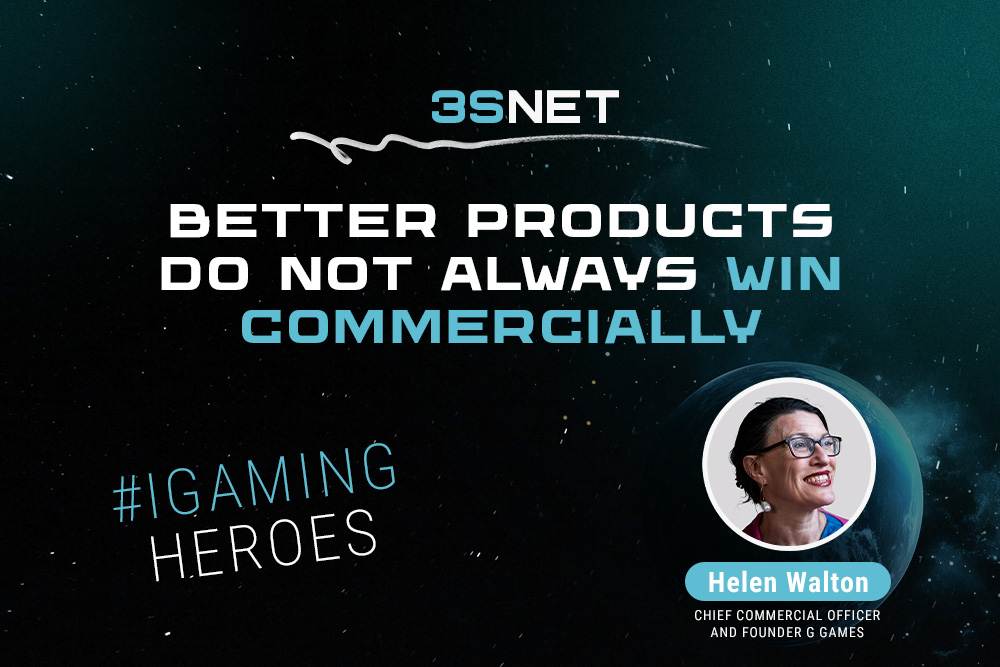
This 3S.INFO interview for iGaming Heroes tells the story of an entrepreneur who moved into iGaming from the worlds of branding and consumer goods. Together with her partners, she built a games studio from scratch, without any prior industry experience. At the heart of the conversation with Helen Walton, Chief Commercial Officer and founder of G Games, are several key themes: naivety as a surprising advantage in the early days, the courage to scrap an expensive prototype in pursuit of a product with real staying power, and the ongoing quest for lasting competitive advantage in an increasingly crowded casino content market. Let's begin!
Before iGaming, you had a completely different life: Cambridge, Unilever, ten years in branding, books on delivering software. Then came a chance conversation, and you and your partners founded a games studio knowing nothing about the industry. Was that naivety a handicap — or is it exactly what let you build G differently?
There’s a great saying “fools rush in where angels fear to tread”. If you knew how hard starting a business was, or writing a novel, or having a child – you’d never do it! Naïve ignorance can be very helpful! I think we’d have shortcut our time if we’d had experience – we’d have found it easier to raise money; easier to get the first few customers – but we would not have seen so clearly that there might be space for a type of product outside the existing game types.
At the end of the day, the skills are the same whether you’re developing a personal care product, an education programme or gambling software. You’re identifying a customer need or desire and finding a way to create and market a product or service that delights them.
- What is G Games? It's a studio that develops real-money games for the iGaming market. The company produces content for online casinos and operators, including slots, table games, lottery products and video bingo. A key focus for G Games is multiplayer slots, where traditional slot mechanics are enhanced with elements of multiplayer video gaming.
You've said that in this industry "industry experience is sometimes overvalued while a fresh influx of experience from other industries is undervalued." You came from consumer brands yourself — Unilever, consulting for the likes of Jamie Oliver. What did you bring from that world into games that teams raised inside gambling simply don't do?
We asked ourselves why gambling games looked and felt so different to other types of games you played on your mobile. Rather than being satisfies with “we tried that and it didn’t work”, we kept asking if we could make something that was more engaging and more fun.
When you started G, you and your co-founders agreed to take one year unpaid. As you put it: "that one year turned into six – which was… challenging, shall we say." What kept you going once it became clear how much longer and harder it would be than you'd expected?
Sunk cost fallacy may be a fallacy, but it’s a helpful one when it comes to resilience!
There was always a tempting prize just on the horizon that kept us going… still is!
Your new flagship, 99 Royale, took five years to build. Along the way you scrapped a finished prototype that cost around £5 million and rebuilt the whole thing from scratch. How do you make a decision like that — to kill something you've already poured years and money into?
In testing, people kept saying “oh this is really great” and then put the phone down on the table.
We looked at what they did. Not what they said. We knew that the game wouldn’t work if it was just a gimmick We needed a product that some people wanted to play more – that was what success would look like.
So we scrapped the product and went back to some fundamental questions until we got the behaviour. Tests where people didn’t put the phone down. Where when we went back to presenting slides, customers didn’t look up from the game.
Having said which – it was really painful as a decision. It’s why you need different types of people in a company - perfectionists and pragmatists - and a balance between them.
About that same launch you said something that sticks: "If it fails – in a really important sense – it won't matter. At least we have tried to build something we really care about; that we are truly proud of." Is that genuine — or is it just an easier way to walk into the biggest bet of your career?
When you talk about the difficulties of being an entrepreneur, most people think about crises as being stressful: cashflow problems; compliance fears; software mess-ups; customer cancellations. Actually, the big crises are rarely the most exhausting or upsetting. It’s the day-to-day that wears you down, not the big event.
And the same is true of big existential questions around the company’s success or failure. If we give our very shot to do something we’re proud of and it then doesn’t work out. That’s ok.
All of us could go get other jobs – often easier and better paid ones! So the thing that matters is trying something brave and exciting that you believe in.
You describe the casino content market as polarised: at the low end, high volumes of cheap commodity content; at the high end, a few blockbusters with real communities. And you say the worst place to be is stuck in the middle. Why is the middle a trap, and how did you know you had to move to the edge?
Five years ago, we could see pressure on margins was increasing; that the quantity of studios and content was growing but that the market share of the biggest guys was growing. We took a long hard looks at our content and asked ourselves what our USP was. We did not like the answer.
Rather than just closing our eyes and hoping the next game would be ‘the hit’ which would solve everything, we started looking for areas of lasting competitive advantage.
99 Royale is a bet on being different. But as you pointed out yourself — "We could not win on an even bet, so we need to be different," while the game still couldn't be so niche that a giant like bet365 would pass on it. How did you find the balance between "bold enough" and "sellable to a major operator"?
Be distinctive without being polarising – that’s the eternal trick for mass marketing. 99 Royale is very bold and ambitious but at the same time it’s just a slot. If you can hit a spin button and a fire button then you can play it and win. Also, although it’s so different for gambling – we’re not reinventing the wheel here. Other single player games have reinvented themselves and found new audiences as multiplayer games – why not slots?
You're Chief Commercial Officer, and you often repeat that distribution is its own discipline — not something you think about once the product is finished. What do most product teams realise about distribution too late?
The most dangerous delusion in product is: if you build it, they will come.
Better products do not always win commercially.
From the very beginning I knew I would never forgive myself if we didn’t give 99 Royale its best shot at success by focusing on rollout and sales. It’s a constant tension as we try to balance delivery effort with future development, and it won’t end with launch. We need to build communities with operators, influencers and players – without undermining the flow of new features and titles.
You've worked with your two co-founders for fifteen years, and you describe it as feeling like "a real family: built on trust and, at times, love, but also irritation and frustration." Over that kind of distance, what holds a partnership together — and what actually wears it down?
If I could set out rules (and I’d love to!) I would stress how important it is to maintain respect for one another’s expertise and specialisms. To remember not to ascribe malicious intent to actions, and not to hold grudges – even when you are 100% convinced you are in the right. It’s no different to any other work relationships in the end – but more intense, and because you can’t just change jobs when you’ve had a bad month or year, you can’t just give up on each other.
Someone once told me that bad times in a marriage were like bad weather – just wait for it to pass. That’s true between business partners too. You’re running this thing together. You can get cross and fed up, but at the end of the day it’s just weather. Endure. It will pass.
"It's hard to be proud of doing the same thing over and over," in your words. What scares you more: failing at something bold, or succeeding at something safe?
Success is success. I think a better comparison is – would you rather fail big at something bold or scrape by at something safe? As you might expect for someone in my line of work I’d tell you to look at the expected value and the probability ;-) In the recent July 2026 YouGov survey of 4,600 adults, people were offered a choice between a guaranteed £50,000 cash or a 50/50 coin flip for £1,000,000. I am all about the 500k EV – which puts me firmly in the minority!
Want to become one of the iGaming Heroes and make your mark in the industry? Fill in the form! It only takes a few minutes, and the participation questions are already set.
Join our Telegram community to stay updated on new content, announcements and exclusive interviews with CPA market experts.
Rapid fire
• You've named one of your weaknesses as being bad at tolerating boredom. What's the most boring part of your work today?
Compliance – it’s incredibly important, so I can’t ignore it, but it’s also not an area I’m naturally interested in. I like the big questions, but when we get down to the process of checking off each regulation, researching updates and collating the evidence to show we’ve done what we say we have… I hate it. But as I say – it’s crucial, so I just have to grit my teeth and not let the boredom get to me.
• What's the most overrated thing in iGaming right now?
Operators used to claim they had an amazing personalisation engine. Now they call it and AI personalisation algorithm. Everything still looks the same.
• A competitor's game you secretly admire?
I really like Pirots – I love the animation and the sounds. Someone who really enjoys gameplay has worked hard so that even a losing drop has a certain kind of satisfaction. I think it’s a game where attention to detail really shows.
• One piece of advice for the Helen who's just founded the studio and knows nothing about the industry?
Cashout would have been huge if only you’d seen the opportunity for multiplayer in it!! Just because one casino manager doesn’t like it – don’t give up!
• How do you recharge so you don't burn out?
Know yourself and what works for you. I don’t take many holidays, certainly not ones where I switch off – but I do make the most of flexibility in my day. If I don’t feel like working one afternoon, then I don’t force it. And I have a lot of things that give me huge pleasure outside of work – gardening, pottery, walking, rowing, reading, cooking, nerding out with my daughter... Work is a big part of my life, for sure, but I don’t let it take over.