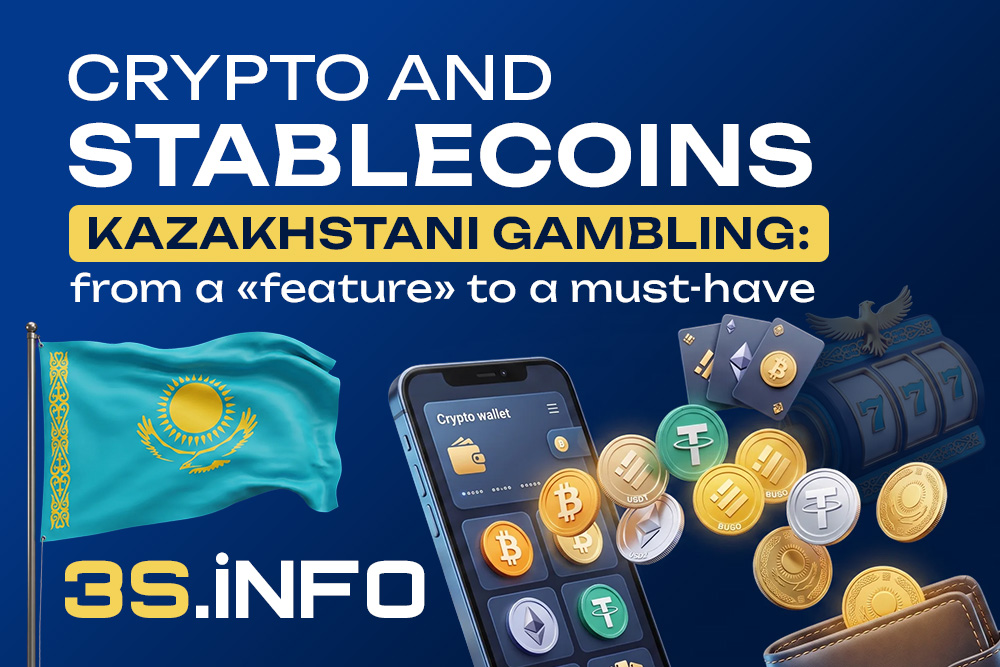
In 2026, Kazakhstan is taking an interesting turn. The country is cracking down hard on illegal online casinos and unregulated crypto flows, while simultaneously rolling out regulation for digital assets and stablecoins through the AIFC and the National Bank. For affiliates, this is not a signal that crypto traffic can be used anywhere. On the contrary, any online gambling or crypto‑gambling activity outside the legal framework remains a high‑risk zone.
But looking more broadly, crypto and stablecoins are already reshaping the payment infrastructure around Kazakhstani betting and the financial sector as a whole. As of May 1, 2026, a systemic legal framework for digital asset circulation has been introduced. The National Bank has approved rules for issuing fully backed stablecoins, and the AIFC has legalized the operation of several crypto exchanges, including Binance, Bybit, and the local project ATAIX Eurasia.
For iGaming, this means that stablecoins and crypto cards are becoming tools that players use in their daily financial lives. Ignoring this fact when planning traffic and products is no longer an option, even if licensed Kazakhstani operators don't accept crypto directly.
This content serves informational purposes only. We do not endorse violations of local laws or service policies. Please familiarize yourself with local regulations and comply accordingly!
Market and Regulation: The Intersections and Boundaries of Crypto and Gambling
First, it's important to honestly map the boundaries.
What is legal in gambling? Under Kazakhstan's Law on Gambling Business, online casinos and poker are prohibited. What remains legal includes:
- Land‑based casinos in gambling zones.
- Land‑based bookmaker shops.
- Online betting through licensed bookmakers via the UAS/Unified Accounting System.
Operating an online casino is classified as a criminal offense under Article 307 of the Criminal Code of the Republic of Kazakhstan and can carry a penalty of up to 7 years in prison.
What is legal in crypto and stablecoins? As of 2024, the AFM explicitly stated that the issuance and circulation of unbacked digital assets such as Bitcoin and Ethereum are prohibited in Kazakhstan, with the exception of crypto exchanges licensed by the AIFC.
From 2026, the situation within the AIFC framework is changing:
- The issuance of certain types of stablecoins is permitted at the AIFC level.
- Eight crypto exchanges have received AIFC licenses (Binance, Bybit, ATAIX Eurasia, etc.).
- The National Bank has approved rules for the issuance of fully backed stablecoins, requiring 100% reserves, separate custody of investor funds, and a limited circle of issuers, such as LLPs or JSCs with capital of at least 200 million tenge.
- The National Bank has launched an official stablecoin, Evo, pegged to the tenge for payments via crypto cards.
At the same time, illegal operations with unbacked crypto, including P2P payments for goods and services and transactions in Bitcoin or Ethereum outside the AIFC, remain prohibited.
Where the state's position on crypto and gambling intersects
- Banks and payment systems are required to block all transfers to online casinos and illegal gambling sites, including transactions conducted through crypto exchanges and digital assets outside the AIFC framework.
- Crypto gambling in Kazakhstan is described in public reviews as restricted. Licensed operators do not accept cryptocurrencies, and most sites that work with crypto are considered offshore and illegal for residents.
The takeaway for affiliates: the local legal product is online betting through the UAS. Crypto in the context of gambling remains, for now, more of a financial backdrop and AIFC infrastructure than a direct "deposit stablecoins and play slots" tool.
- Kazakhstan's iGaming market in Central Asia remains highly attractive to operators. However, the key challenge in 2026 is no longer competition or regulatory barriers, but payment infrastructure. A user may complete every stage of the funnel, from ad exposure to verification, but a failure at the final deposit step can erase all marketing investment. Read more: Payments in Kazakhstani iGaming: What Works, What Gets Blocked, and Why Crypto Matters.
How Do the National Bank's New Stablecoin Rules Affect Affiliates?
The new National Bank rules don't automatically make crypto payments in gambling legal, but they do change the context in which affiliates work with the KZ audience. As of May 1, 2026, stablecoins in Kazakhstan are gaining a regulated status. They must be 100% backed by fiat, and only JSCs or LLPs with capital of at least 200 million tenge are allowed to issue them.
What Does This Change for Affiliates?
1. Stablecoins become a more clearly defined financial product.
Previously, crypto in user communication was often associated with P2P, offshore exchanges, and high legal risk. The new framework separates stablecoins into a distinct category of digital financial assets and establishes rules for issuance, placement, circulation, and redemption.
For content‑focused affiliates, this means growing demand for clear educational materials, such as:
- What a backed stablecoin is.
- How it differs from BTC, ETH, and other unbacked digital assets.
- Which market participants are authorized to handle such assets.
- What AML/KYC procedures may accompany transactions.
- How to verify a service's status and avoid falling into an illegal scheme.
2. The new rules cannot be presented as permission to pay for gambling with crypto.
This is a key point. The National Bank's regulations govern digital financial assets and stablecoins, but they do not legalize crypto deposits in online casinos or settlements with unlicensed operators. For the KZ market, it's still essential to distinguish between:
What Can Be Discussed | What Cannot Be Promoted |
| Regulated stablecoins, licensed platforms, financial literacy | Crypto casinos and casino offers for KZ residents |
| Legal sports betting with local licensed bookmakers | Crypto as a way to bypass bank blocks, KYC, or restrictions |
| AML, payment security, service status verification | P2P schemes and transactions through unregulated exchangers |
| Collateral, redemption, and risks of digital assets | Promises of "anonymous" or "control‑proof" deposits |
The National Bank emphasizes that the key elements of the new regulated digital asset framework came into effect on May 1, 2026, and that transactions must be conducted through controlled market participants.
3. The value of compliance‑focused content is growing.
Issuers are required to issue stablecoins with full fiat backing, disclose issuance information, and comply with redemption requirements. The rules also provide for stablecoins pegged to a single currency, along with documentation and admission procedures.
For affiliates, this means that trust in content can now be built not on bold promises, but on verifiable indicators:
- Whether the service has a regulated status.
- Who the issuer is.
- Whether the asset is backed.
- Whether redemption rules exist.
- Whether terms and risks are disclosed.
- Whether users go through KYC.
4. The risk of strict anti‑fraud measures is increasing.
The new framework doesn't reduce control; it makes it more technologically advanced. Regulated exchanges, exchangers, and digital financial asset platforms must operate under supervision as well as open and maintain user wallets within the established model.
If an affiliate buys traffic in financially sensitive topics or works with betting offers, this means:
- Suspicious traffic and "crypto‑motivated" leads are more likely to trigger KYC and AML checks.
- Conversion holds may increase if the operator has questions about the source of funds or deposit patterns.
- Transparent sub IDs, S2S postbacks, approved sources, and the absence of incentive mechanics that encourage users to engage in questionable transactions are becoming especially important.
5. New legal content funnels are emerging.
A direct gambling offer via stablecoin doesn't become a must‑have. However, adjacent funnels are appearing:
- Reviews of regulated crypto exchanges and digital financial platforms.
- Explanations of stablecoins pegged to the tenge or another single currency.
- Comparisons of storage, purchase, and redemption methods for digital assets.
- Articles on the digital tenge, crypto cards, and regulation.
- Fintech content for financially literate audiences.
Such content can be used for acquisition and trust building, but it should not be mixed with calls to fund illegal gaming products.
Practical Takeaway
For affiliates, the National Bank's new rules are not a green light for crypto gambling, but rather a shift toward a more transparent financial infrastructure. Those who stand to benefit are the ones who:
- Work with legal betting offers and licensed financial services.
- Verify the status of the product, issuer, and payment provider.
- Build educational content rather than promising anonymity or a way around restrictions.
- Account for stronger KYC, AML, and fraud controls in their funnels.
- Measure traffic by confirmed deposits, retention, and cohort quality, not just registrations.
This is why stablecoins are becoming an important topic for KZ‑based affiliates. Not as a way to bypass rules, but as a new layer of regulated fintech that shapes audience expectations, payment scenarios, and traffic quality requirements.
Why Crypto and Stablecoins Are Already a Must‑Have for Understanding the Market
1. The player's financial life is changing.
Even if a licensed Kazakhstani bookmaker doesn't accept crypto directly, some players are already using stablecoins and crypto cards in their daily finances, for example, to pay for other services, make transfers within the AIFC ecosystem, or store funds.
For affiliates, this means:
- A portion of the audience will be more sensitive to topics like security, AML/KYC, and blocks.
- Interest in deposit methods through AIFC exchanges and official crypto cards will grow.
- Content around payments, blocks, and workarounds will become a key information driver, and it needs to be handled carefully, without encouraging users to break the law.
2. AML and operator risk teams are making scenarios more complex.
Stablecoins and regulated digital asset circulation are not a legalization of crypto gambling, but rather a reinforcement of AML controls. In iGaming, this will lead to:
- Stricter checks on the source of funds.
- A clearer separation between white payment channels and suspicious schemes.
- Greater attention to abnormal deposit and withdrawal patterns.
For affiliates, this is not a reason to write "how to bypass a block," but rather a reason to understand that high‑risk crypto schemes can increase KYC rejection rates, extend holds, or raise red flags around traffic.
3. A niche for hybrid products is emerging.
Regulated crypto and stablecoins in Kazakhstan remain part of the AIFC and National Bank financial ecosystem. For the iGaming market, this could mean:
- The emergence of hybrid fintech products, such as crypto cards and multi‑currency wallets, within the legal space.
- Growing demand for local content on stablecoins, the Evo token, licensed exchanges, and AML rules.
- Interest in products at the intersection of fintech and entertainment, which affiliates will need to account for.
The world is seeing a paradox: cryptocurrency may be legal as an asset, but that does not automatically permit its use for online casino deposits. Regulators clearly distinguish between the legal status of crypto assets, which covers taxation and reporting, and the regulation of gambling, which involves licensing, KYC, and permitted payment methods. Owning Bitcoin does not mean being allowed to bet with it. So how legal is it to use crypto payments in iGaming?
How Affiliates Can Safely Navigate the Crypto Topic in Kazakhstan
1. Don't promote "crypto casinos" for KZ.
Any offers that directly promote online casinos or crypto casinos for residents of Kazakhstan fall outside the legal framework. The focus should be on:
- Legal online betting with licensed bookmakers.
- Content on the market, payments, blocks, and stablecoins as part of the user's financial life.
- Careful wording that avoids encouraging the use of crypto to bypass blocks or financial controls.
2. Focus on educational content.
Players need honest breakdowns of:
- What the AIFC is and why only licensed exchanges can handle crypto.
- How the Evo stablecoin and similar tools are regulated.
- How prohibited transactions with unbacked crypto differ from legal AIFC‑compliant deals.
- How banks track transfers to online casinos and high‑risk crypto exchanges.
- Why it's better not to use crypto through questionable schemes for an "easy" deposit.
This not only reduces risk but also builds trust in your resource. Users see that you're not selling gray workarounds, but actually explaining the rules of the market.
3. Segment your audience.
In Kazakhstan, several segments can be identified:
Segment | Attitude Toward Crypto | What Matters in Content |
| Mass‑market player | Crypto is more of a "scary and confusing" topic | Simple explanations of risks and blocks, with a focus on the UAS and legal payments. |
| More financially literate users | Interest in the AIFC, stablecoins, and crypto exchanges | Detailed breakdowns of the legal framework, taxes, restrictions, and AML. |
| Crypto enthusiasts and P2P users | Has experience, but not always a full understanding of the law | Careful content on the risks of illegal operations, blocks, and criminal liability. |
| Business audience | Sees crypto as tools for balance and investment | Market analytics on digital assets, regulation, and financial stability. |
Affiliates don't have to pitch gambling to every segment the same way. The key is to filter who gets what content and where it's better to stop at general explanations.
Scenarios for Crypto in KZ Gambling Over the Next 12–24 Months
Scenario 1. Stablecoins as a Backdrop, Not a Channel
The National Bank and the AIFC continue to develop Evo and other stablecoins, but licensed bookmakers do not accept crypto payments directly. For affiliates, crypto remains part of the player's financial context rather than a separate offer line.
What to do: work with betting offers, educational content, and honest reviews of the digital asset market.
Scenario 2. Fintech Products at the Intersection with iGaming
Official fintech services emerge that allow users to fund a wallet via stablecoin and then transfer funds to legal betting products. AML controls are tightening, but crypto is no longer operating in the shadows.
What to do: closely monitor the licensing status of such solutions, avoid promoting anything that falls outside Kazakhstan's legal framework, and focus on UX, speed, and secure usage scenarios.
Scenario 3. Gray Workarounds and Intensified Blocks
Some players and projects attempt to use crypto through unlicensed exchanges or P2P channels to deposit into offshore casinos. Banks, the AFM, and the Committee for Gambling Regulation are stepping up blocks on such transactions and increasing scrutiny of anomalous financial patterns.
What to do: avoid building a business model on gray schemes; focus on sustainable solutions that don't conflict with AML, the UAS, or criminal law.
Cryptocurrency and Stablecoins in Kazakhstan: Key Takeaways
Crypto and stablecoins in Kazakhstan have already ceased to be just a "feature" for enthusiasts. They are now a full‑fledged part of the financial architecture, but so far not a direct payment tool for licensed gambling. For affiliates, this means that the topic of digital assets cannot be ignored when understanding the KZ market, but it also cannot be used to bypass the rules.
The path to long‑term success in Kazakhstan lies in working with legal betting products, honest content on regulation, careful coverage of stablecoins and crypto infrastructure, and respect for the fact that the state views illegal online casinos and unauthorized crypto flows as matters of criminal liability, not marketing.