An honest interview on 3S.INFO reveals how a "random" project evolved into an international business that has stayed in one niche for over two decades. How does a developer's mindset shift to that of a business leader? How have major crises, from "Black Friday" to tightening regulations, shaped the company's strategy and its expansion into global iGaming? What branding mistakes and missteps in the casino vertical had to be acknowledged? And how did they reshape the company's approach to marketing, team building, and personal growth? Meet our new iGaming Hero: Dmitry Starostenkov, CEO of EvenBet Gaming!
- What is EvenBet and what does the company do? It is a B2B developer with over 20 years of experience, creating software for online poker, casino, and card games. The company provides technological solutions for operators launching new projects or modernizing existing platforms, from casinos to bookmakers.
- Poker landed in your lap almost by accident. Over 20 years, has the thought ever crossed your mind: "That's enough, let's move on to something else"? And what kept you in the game each time?
There was never a thought of "giving up poker" as a business. There were tough moments, especially around regulatory changes, when the rules of the game shifted faster than we could update the code. But what always held us was the product itself. Poker is the pinnacle of mathematical and social engineering in iGaming. It's not a script. It's a living ecosystem and a community. When you realize you're running a platform where millions of people compete on intellect, moving to e‑commerce or standard fintech feels like a downgrade. We're not just holding on to poker. We're setting new standards for it.
- When you took on your first poker project, what turned out to be the most unexpected thing? Not about technology, but about people, the market, and the industry.
What struck me was the depth of player engagement. In regular development, the user just wants the button to work fast. In poker, people treat the software as an extension of their hands and thoughts. Any change to the interface, element placement, or card animation logic still triggers a storm of reactions on the forums. We realized instantly that we were not just building software. We were building a digital entertainment environment for a highly demanding, intelligent, and critical audience. There's no room for cutting corners here.
- You came into the business as a developer. At what point did you realize that thinking in code was no longer enough?
When the company's scale outgrew the physical ability to oversee every line of code, and the challenges shifted from "how to write this" to "why does the market need this, and how will it make money for our partners." A developer looks for an elegant technical solution. A business leader pursues a solution that creates value. The turning point came when I realized that people and processes are a far more complex and unpredictable system than code. Code operates on strict logic. Business and markets follow psychology, economics, and a constantly shifting environment.
- In 2011, "Black Friday" shut down the US market, while your business was largely built on its expectations. How did you make decisions in a crisis you didn't create?
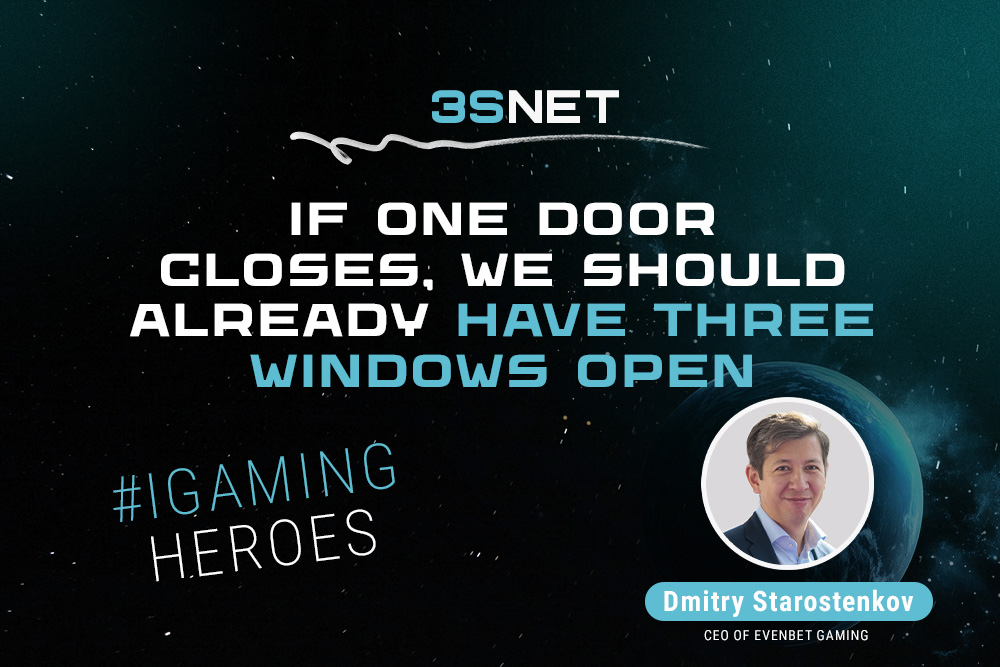
The 2011 "Black Friday" was a tectonic shift for our entire industry. The key lesson I took away from it was this: you cannot bet a company's future on a single geography or a single regulatory model. We made the decision to diversify. Instead of waiting for America to "thaw out," we swiftly pivoted to markets in Latin America, Asia, and Europe. A crisis we didn't create forced us to become truly global. We learned to be agile. If one door closes, we should already have three windows open in other parts of the world.
- Poker is a game against people, not against the system. How does this change the product philosophy?
In fact, it changes everything. In casinos or slots, the operator profits from the player's loss. In poker, the operator profits from people playing, through the rake. Our goal as a platform developer is not to take money from the user, but to make sure they find it interesting, safe, and comfortable to stay at the table for as long as possible. Our product philosophy is about maintaining a healthy game ecosystem, including liquidity, bot protection, and balance between professionals and amateurs. We build the stadium and provide the best equipment. We don't play against the audience.
- EvenBet spent 20 years building itself around poker, but now you're entering the casino space. Is this evolution or a concession to the market?
It's pure evolution, driven by what our partners and clients actually need today. Operators no longer want to piece together a product from multiple vendors. They want a complete solution. The casino vertical is our way of giving them maximum player retention within a single ecosystem. Poker remains in our DNA, our superpower, but now we're enhancing it with the full spectrum of iGaming capabilities.
- Was there an idea or strategy you publicly believed in, but later had to admit: "We got it wrong"?
Yes, there was such a moment. When we entered the casino and game aggregation market, we launched this vertical under a separate brand. It seemed logical to separate poker and casino to avoid confusing the audience. But the market and our partners quickly proved otherwise.
Clients came to us for a casino platform, but they wanted to work specifically with us, the team whose technological reliability they trusted. The EvenBet Gaming brand is trusted unconditionally, and the sub‑brand only made communication more complicated. We recognized this decision was not entirely right in time and consolidated all products under a single name. This not only simplified integration for operators but also paved the way for our current ecosystem, where poker and casino reinforce each other.
- You've been building one business for over two decades. What has been the hardest part: creating the product, building the team, or staying interested in the same thing for so long?
Staying interested is actually the easiest part, because the business itself is constantly changing. Poker from twenty years ago and today's product are two different planets. The hardest part has been transforming the team and transforming myself. Outgrowing a small development studio and building an international corporate structure, where processes work systematically and people across different countries share the same values — that's the real challenge. And it continues for me every single day.
- If today's Dmitry Starostenkov could meet himself at the start of his journey, what advice would he give?
Invest in brand building and marketing five years earlier than you plan. At the beginning, as an engineer, I believed that perfect code sells itself. That's an illusion. A great product without strong positioning and the right market communication will go unnoticed. A business must not only create brilliantly but also speak loudly and clearly about its value.
Stepping out of familiar development into business and marketing is a huge leap outside the comfort zone. Maybe basic talent can be innate, but the discipline of change is something you develop within yourself. Many people want to change things, but few are willing to tolerate the discomfort that comes with it. This skill is only trained when you consciously and regularly put yourself in the position of a beginner. It's like working out a muscle. The more often you go through transformation, the more confident you become in the process of change itself.
If you've been in iGaming for a while, it's time to stop following and start setting the direction. No fluff here: only working strategies, the details that make the difference, and cases that aren't shouted from every rooftop. Join the discussion and level up your approach with us.
For daily updates, subscribe to the 3SNET Telegram channel: just useful content, no noise.
Quick answers
1. The most overrated term in iGaming?
"Innovative." These days, it's used to describe almost any minor update. True innovations in the market are rare. The rest is quality marketing, or not so quality.
2. What's harder: building a product or building a company?
Building a company. A product follows the laws of math and logic. A company is made up of people, and people are the most complex, unpredictable, and delicate matter.
3. What's tougher as a business: poker or sports betting?
Poker. In betting, you manage margins and odds against sports events. In poker, you manage an ecosystem where players compete against each other. Even the smallest imbalance in the gaming environment, such as an influx of bots, can instantly destroy the operator's entire business.
4. What will never change at EvenBet Gaming?
Our focus on technological reliability and integrity toward partners. We can change design, enter new verticals like casino, and expand platform capabilities. But product quality and the value of trust within the business are our unwavering foundation.
5. If not iGaming, what would you be doing?
Probably deep scientific chemistry. In my youth, I was seriously into it, studied in a specialized chemistry class, and planned to build my life around it, until programming took over. Chemistry and developing complex systems have a lot in common. In both, you search for ideal formulas, manage invisible processes, and try to build a working structure from scattered elements.
If we're talking outside of business, I might have gone into underwater photography professionally. It was once a huge passion of mine, requiring intense focus and emotional commitment. For now, I channel that explorer's drive into regular running and growing the company.