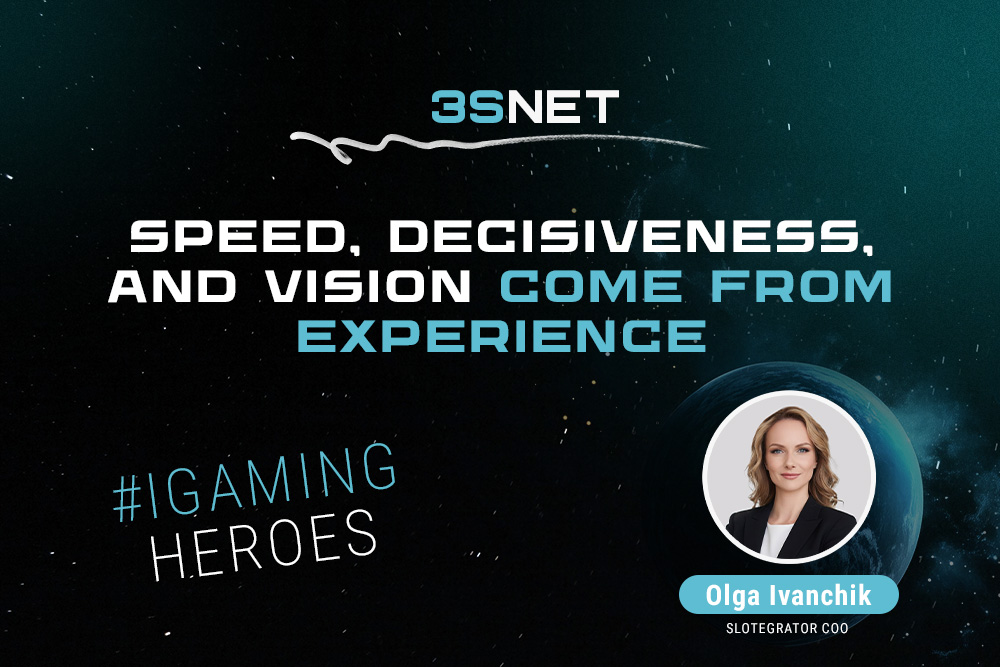
How does education, personal experience and exposure to different leadership models, from inspiring to toxic, shape a leader? Why does first-hand experience become the main "architect" of one's management style? How does the invisible work of maintaining team motivation, continuously auditing processes and building systems through delegation become the most challenging and energy-consuming element of leadership? Why does the industry underestimate artificial intelligence, using it only to optimize current tasks rather than as a driver of deep, long-term market transformation? Today, Olga Ivanchik, COO of Slotegrator, joins the iGaming Heroes column on 3S.INFO to answer these and other questions.
- Looking back, what has influenced you the most as a leader?
Influences can come from a lot of different directions. My higher education in management provided me with a strong foundation of practical knowledge, while the MBA program expanded it into a global context. However, the most valuable lessons were practical ones, gained from the people I worked with throughout my career. I was fortunate enough that these included inspiring examples of mature leadership, where managers successfully balanced the interests of both the business and the team, steadily developing each side. At the same time, I also encountered memorable examples of toxic leadership through devaluation, neglect, and manipulation — but even a negative experience can have a positive influence if you reflect on it; learning what not to do is still learning. Overall, I’d say that as you grow into a leadership role, the experiences you go through personally — both positive and negative — have the greatest impact on shaping you as a manager.
- What aspects of the COO role turn out to be the most challenging in practice, even though they’re almost invisible from the outside?
For me, it’s giving employees a sense of purpose in their day-to-day work. The reason it’s challenging is the level of care and attention it requires to do right. Beyond salary and career growth, everyone has their own motivations at work — whether it’s the opportunity to act as a mentor, gain knowledge from related fields, or facilitate cross-team collaboration. Achieving this requires time, trust, and sometimes patience, because working with people is one of the most energy-consuming aspects of management, but at the same time, it often brings the most valuable results. If you’re willing to take the time to connect with people and find out what motivates them, you’re much more likely to get the best out of them.
- What signals tell you that a company has outgrown its current processes?
Processes require continuous auditing and improvement. This cycle should never stop, so realistically, a company shouldn’t outgrow its current processes; if the company has grown, the processes have already grown, too. We constantly create new products, improve existing ones, enter new markets, and implement new practices, as every area is constantly evolving, from HR to development and business analysis. Overall, for implementation to be effective, existing processes must be continuously reviewed critically and optimized.
- Have you ever made a decision that seemed absolutely right at the time but later required a rethink? What did it change in your approach?
Yes, I’m sure it happens to everyone. I tend to make decisions quickly, but before implementing them I always assess the risks. In many cases, the possibility of revisiting a decision is already considered at the decision-making stage, and becomes part of the overall strategy. In a fast-changing environment like iGaming, this is completely normal — flexibility and the ability to adapt are essential parts of an effective approach.
- At what point does a leader need to stop “doing everything manually” and start building a system?
In my opinion, it’s immediately. Your job as a leader isn’t to be the best at everything; it’s to develop a vision and carry out the planning to make it happen. Delegation is essential to execution, so as a leader, you should be setting up the right teams and empowering them. When you’re building a system, it’s useful to ask yourself: would these processes still be effective if I wasn’t here? If the answer is “yes,” then you’ve built something resilient and effective.
- What qualities in people are non-negotiable for you, especially during periods of rapid growth?
There are a few qualities that I need from team members. Flexible thinking is essential, as is the ability to make decisions quickly but evaluate them critically. Enthusiasm, too, is an absolute requirement. You need people who can think on their feet, reflect on what they’ve done, and keep moving forward without losing energy, especially during periods of rapid growth. Of course, these periods can be highly turbulent, so resilience and an unflagging belief in the project’s success are also absolutely critical.
- How do you balance speed of decision-making with quality of outcomes when the cost of a mistake is high?
Speed, decisiveness, and vision come from experience. Make enough decisions, and you develop the ability to think (at least) five steps ahead at all times. Every decision you make has implications and consequences, and you’ve got to think all of them through. You have to ask yourself: if I take this route, what will be the immediate effect? What effects will there be six months, a year, two years, five years from now? What about all the alternatives? Part of being a leader is constantly having one eye on the future.
- In which areas of management have you become more flexible over time, and where have you become more strict?
Olga: It’s always interesting to see how management styles change over time. In my case, I’ve certainly become more flexible in working with people. Everyone has their own philosophy, approach, and style for how they work, and learning to accommodate those differences can yield some great results.
At the same time, I’ve become more demanding when it comes to results. A deadline is a deadline, and work needs to be delivered on time. I’ve also become very strict when it comes to quality; I need the best possible result you can produce, not a list of excuses. And there simply can’t be wiggle room when it comes to the budget.
- What changes in the iGaming industry today seem underestimated, but could significantly impact the market in the coming years?
This might seem surprising, but I think it’s artificial intelligence. AI adoption is so widespread it’s almost becoming devalued; it seems like every day there’s another company touting another AI-powered solution. But not enough companies are thinking about the long term. They’re underestimating AI in that they use it to optimize current processes, but they’re not taking the full implications into account.
Quick Fire
— What’s your go-to way to reset?
Sport
— What’s the most common mistake when scaling a company?
Trying to do it too fast and expecting immediate results.
— What’s harder: accelerating growth or maintaining stability?
Doing them at the same time.
— When do you realize it’s time to step in personally?
When you hear about the same problem for the third week running.
— When was the last time you felt: “we executed this perfectly as a team”?
The development and launch of our Predictor by Slotegrator prediction market engine.
Your iGaming project has reached the moment to scale up and reach new heights. Want to give your brand a powerful and noticeable boost? Contact us! We’ll promptly analyze your goals and offer the optimal solution.
Stay on trend! Subscribe to 3SNET on Telegram for exclusive interviews and unique insights straight from industry leaders.