Trust and deals in iGaming don't come from visibility alone, and no conference booth, however expensive, can stand in for a strong brand. In an interview with iGaming Heroes, Surya Palli, founder and host of iGaming Real Talk, talks about distinguishing useful content from a chase for reactions, building professional connections beyond LinkedIn, and staying open with potential clients. He also explains how to scale a media business tied to its founder's personality without losing the joy of the work.
- Walk me through your journey — how did you end up in iGaming and get to where you are now: SiGMA, marketing, and now the podcast, community and agency?
It’s actually an interesting story. I was moving between countries in Europe, trying to find a job in marketing, but language and visa requirements were always a problem. Then someone suggested Malta. I didn’t even know Malta was a country at the time! I booked a one-way ticket with around €300 in my pocket and had about 15 days to figure things out.
Luckily, I got an opportunity at SiGMA, and that changed my life. I knew nothing about iGaming when I joined. Everything I learned came through the job. From there, I worked with companies like Betsson, moved to Dubai to work on crypto projects, and eventually started my own iGaming B2B marketing consultancy.
As AI became more common in content creation and everything started looking the same, I wanted to bring something real to the space. The podcast started as a way to create interesting LinkedIn content, build authority, and attract consulting clients.
However, it grew into something much bigger. Today, our WhatsApp community and media business are the main focus. We’ve covered seven iGaming expos and produced 105 episodes this year alone. None of this was really planned. We saw what was needed and kept responding to demand. One thing just led to another.
- Looking to connect with advertisers, find fresh offers, and get to grips with GEO trends in media buying? Then the SiGMA summits in Rome and Malta are worth a closer look. On 2–5 November 2026, Rome will bring together representatives of the iGaming industry, affiliate marketing, and tech and finance companies, with Malta following on 3–5 May 2027. 3SNET&3S.INFO will be there too. Look for our booth, H3-3035. We'd be glad to meet in person, talk through the latest offers and GEOs, and explore opportunities to work together.
- You wrote yourself: "I never imagined I'd become a creator. I had a huge fear of public speaking. My first video was cringe." What made you keep going after that first one?
I thought I didn’t really have many options at that time. I was struggling financially, and I believed the podcast could help me get out of that situation. The first few episodes were extremely uncomfortable, even though I was interviewing people I already knew.
But when we started travelling to iGaming events and doing the Real Roadshow, something changed. I started enjoying it, and that’s when I discovered the passion behind it.
I also realised that when I’m on camera, something changes. It’s almost like the most authentic version of myself comes out because all the filters that usually exist in day-to-day life disappear. It’s as if I’m in a trance, where I’m not thinking about what I’m saying. It just comes out naturally.
Looking back, I’m really glad I continued. I believe there’s always something exciting behind fear, so we should pursue it. We might be surprised by what we discover underneath.
- You ran a poll on the expo floor: do people like a LinkedIn post because of the content, or to support the person? Your takeaway — to support the person. If the whole industry runs on relationships rather than substance, is that a healthy industry or a mutual back-patting bubble?
I don’t think I’m the person who should decide whether it’s healthy or unhealthy. iGaming is heavily dependent on relationships because of the restrictions we have around promoting businesses, both B2B and B2C. That’s also why events are such a big part of this industry.
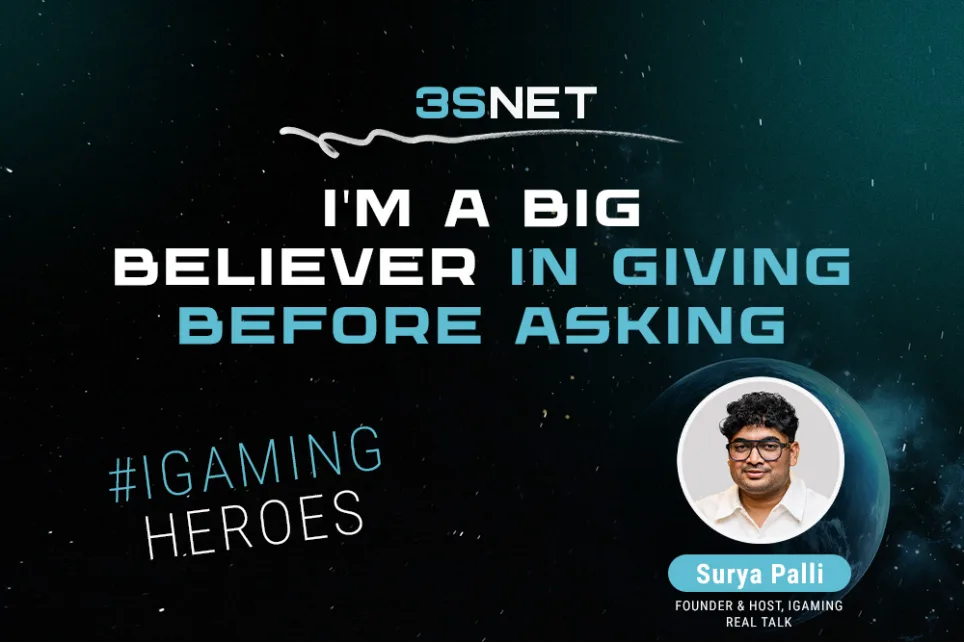
I’m a big believer in giving before asking. It’s something I learned from Gary Vaynerchuk and also practised at SiGMA. You provide value, support people and build relationships without expecting something immediately in return. Eventually, you create opportunities to ask for something in the right way.
The industry works the way it does, and I’m no one to judge what’s good or bad, or what’s right or wrong. I’m here to understand the industry, my audience and the demand, and create something that’s useful and valuable.
- You've said the industry is obsessed with visibility over real work. How do you tell apart a personal brand with substance behind it from pure visibility?
I think it’s quite visible when someone is genuinely trying to provide value and when someone is just looking for attention.
You see a lot of rage-baiting, complaining and people pulling others down to generate engagement. It might get you likes and comments, but what kind of perception are you creating about yourself, especially when you’re also trying to sell something?
And more importantly, are you attracting the right audience? Are these people actually your audience, and will they trust you enough to buy from you?
Engagement is not everything. I believe in creating content that’s useful and valuable, rather than chasing engagement just for the sake of it. But ultimately, it’s up to the audience to decide where they find value.
- You've recorded close to 90 conversations. Every other one circles the same themes: quality over volume, the trust breakdown between affiliates and operators, fake streamers, fake traffic. Why has the industry been talking about this for years — and nothing changes?
I don’t agree that nothing is changing. I think the industry is definitely maturing.
If you look at the 2027 iGaming Trends Report by SOFTSWISS, it shows how digitally advanced iGaming has become compared to other digital industries, including ecommerce and sports.
Of course, we still have problems with trust, transparency and quality, and those conversations are important. But just because we’re still talking about these issues doesn’t mean there’s no progress.
I think a lot is changing, and sometimes our perception doesn’t match what the data is telling us.
- You've recorded close to 90 conversations with people who risked everything, failed, obsessively backed one idea for years. Whose story stayed with you long after — and why that one?
One conversation that really sparked a thought was with Adar.
Until then, I thought having a large network and staying connected with people on LinkedIn was enough. But that conversation made me realise that a real connection means actually talking to people, checking in on them regularly and staying in touch beyond LinkedIn.
I started doing this much more rigorously, and I think it helped us build our community as well. It wasn’t some strategy I followed or a course I took to grow the community. I simply started practicing what I learnt.
I’ve always loved meeting new people and understanding why they do what they do. I’ve lived in nine countries, and I’ve always been curious about how much our culture, environment and society influence the way we think.
The podcast and the community gave me another way to do what I’ve always enjoyed.
- You interview people who could become your clients or sponsors. Have you ever held back an uncomfortable question because the person was a potential deal?
No, I always ask what I feel like asking. My job as an interviewer is to ask the questions that viewers might have while watching the conversation. It’s up to the guest how much they want to reveal.
At the same time, I want guests to feel comfortable, especially when I’m meeting someone for the first time. I believe a lot in energy. If you approach people without judging them or thinking badly of them, they respond differently. And that makes a big difference in how open the conversation becomes.
Of course, there have been episodes where I’ve come home thinking, “That wasn’t enough real talk.” But it is what it is. I can ask the questions, but I can’t force someone to answer. That’s their choice.
I think that’s also why people approach us. They know we’re not doing boring PR interviews, and they can be themselves. That’s what we want to create with iGaming Real Talk.
- You worked inside SiGMA — one of the biggest iGaming conference organisers. Do conferences actually deliver business results, or does half the industry go because everyone else goes?
There’s no doubt that events are extremely important in iGaming. A lot of business happens through relationships, and conferences are where those relationships are built. But I think how you approach events makes a big difference. If you’re a startup spending €100,000 on a booth without having a strong product, a good team, a few clients or any real brand awareness, I think that’s a big mistake.
You need to build your brand first. Make people aware of your product, what makes you different and who’s behind it. Start attending events, meet people and build relationships. Then, once your business grows and you have a solid brand foundation, you can consider taking a small booth and progressively increasing your investment, event by event.
I’ve seen companies spend huge amounts on stands because their competitors are doing the same. But just because your competitor has a massive stand doesn’t mean you need one too. Your event strategy should depend on where your business is today and what you actually need.
- You're a Fractional CMO — an outside marketing director a few hours a week for several companies at once. How many projects have you run, in which verticals — and what do you see on day one in a new company that the internal team no longer notices?
I’ve worked across iGaming, events, crypto, blockchain and technology businesses, from early-stage startups to larger companies. One thing I notice quite often is that companies underestimate the importance of marketing, especially in the early stages. They spend so much time building the product and assume the product will sell itself. It might, but unless you’ve built something as innovative as ChatGPT, you can’t rely just on a product anymore.
And as products become easier to build with AI, I think building a great product will become less of a differentiator on its own. The real challenge is building a brand that attracts customers, brings in great talent and helps the business grow.
I believe marketing is everyone’s job in a company, not just the marketing team’s. Everyone should be talking about the product and helping people understand why it matters from day one.
I’ve always preferred attracting people towards a brand rather than constantly chasing them. And I think that’s where we’re heading. As more products enter the market, the ability to build a brand people recognise, trust and want to be part of becomes even more important.
Essentially, it’s all about building a brand.
- The podcast, the community, the media platform, the interviews — it's all largely tied to you personally. How do you plan to scale it without hitting the ceiling of your own time? And do you even want to — or is the whole point that it's you?
This is something I’ve been thinking about quite a lot. I am the edge of this business, but I’m also its limitation. A lot of what we do is tied to me personally, so scaling comes with its own challenges.
But it also comes down to what I actually want. Do I want to build a hundred-person media company, or do I want to build a business that allows me to keep doing what I love?
I think I’m leaning towards the second option. I love travelling, meeting new people, having interesting conversations and working with people I enjoy working with.
If I can build a good business around that, keep growing it and still enjoy what I do, I’m content. I don’t feel the need to build a massive company just because I can.
At least that's how I see it today. We'll see what happens in the next few years.
Want to get known in iGaming? Drop us a line, and we'll talk through your experience and find an interesting format to introduce you to the industry. Exclusive materials and interviews with industry leaders are in the 3SNET Telegram channel. Subscribe so you don't miss the best of it!
Rapid-fire
- The best guest you haven’t landed yet?
I don’t really have a dream guest list. For a long time, I wanted to interview Alexandre Tomic, and we finally made it happen. I think he’s one of the greatest guests we’ve had. So right now, there’s no particular person I’m aiming for.
- A question you ask everyone, and it always works?
I can tell you one that never works. “What are your plans for the next few years?” Nobody wants to reveal their plans because competition is so intense in iGaming. Products can be quite interchangeable, and someone bigger with more resources could execute your idea faster. So, I’ve actually stopped asking that question.
- One interviewer skill that’s underrated?
Being yourself. I think people put too much effort into trying to be someone others will approve of. Just be your true self. It doesn’t take any effort to be yourself, but it takes confidence. Even if people don’t agree with you, they can still feel when you’re genuine.
- What still surprises you about this industry?
That there are companies that spend millions on exhibition stands that last only three days. I understand the business value of events, but I think there’s a lot of unnecessary spending. Sometimes you could achieve similar results with a fraction of the budget.
- iGaming in five years, in one word?
Unimaginable. With everything happening in AI and technology, it’s difficult to predict where the industry will be in five years. It’s crazy to even imagine it.