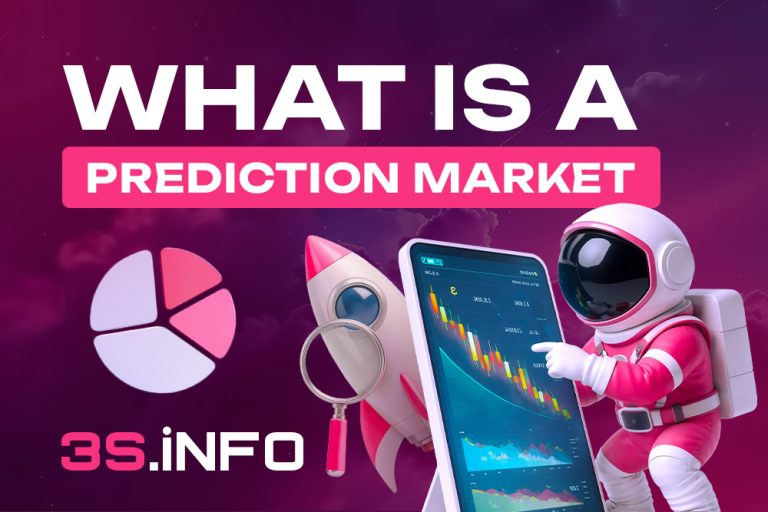

What Is a Prediction Market?

The prediction market has evolved into a multi-billion-dollar industry: what this phenomenon entails, why it is gaining traction, and what challenges it faces.

Last Updated: 2 april 2026

In recent years, the prediction market has evolved from an exotic tool for political scientists into a multi-billion-dollar industry, drawing the attention of both professional traders and regulators worldwide. In this article, we break down what this phenomenon entails, why it is gaining traction, and what challenges it faces.

Prediction Market: What Is It and How Does It Relate to Bets on Weather, Elections, and the End of the World?

A prediction market is a platform where people essentially trade probabilities of future events.

It’s not simply “betting on an outcome” like in traditional betting. Instead, people buy and sell contracts whose price reflects the collective assessment of the probability of a given event.

Imagine a simple market with a question:
“Will Bitcoin’s price be above $100,000 by the end of the year?”
There are two types of contracts: “Yes” and “No.”
If the “Yes” contract is currently trading at $0.35, this is interpreted as “the market sees the probability of this event at around 35%.”
If the event occurs, the “Yes” contract pays out $1, and the “No” contract pays $0. If it doesn’t — the opposite.

This is how the basic mechanics of a prediction market work:

  • You buy a “share” of an outcome you believe is undervalued;
  • The price moves as further news and trades come in;
  • The final settlement happens based on the actual outcome (according to a pre-agreed source of truth: media, official statistics, blockchain oracle, etc.).

What is a prediction market in simple terms?

To put it in plain language:

  • In betting, you wager against the bookmaker based on their odds.
  • In a prediction market, you trade with other participants, and the price is the crowd’s aggregated opinion about the probability of an event.

Formally, this is closer to a stock exchange than to a bookmaker:

  • There are contracts for outcomes;
  • There is an order book;
  • You can not only “hold until expiration” but also exit earlier, locking in profit or loss.

Typical topics for prediction markets:

  • Politics (election results, referendums, impeachments);
  • Economy (Fed rate, inflation, GDP, recessions);
  • Crypto and finance (asset prices by a certain date);
  • Sports and esports;
  • Pop culture and meme events (Oscar winners, divorces, releases, “dollar at X”, etc.).

Why People Choose This Type of Betting

There are several reasons. They’re more honest than just “I want adrenaline.”

  1. Intellectual casino: here, you can monetize not only intuition but also knowledge of the market, politics, and economics. Many see prediction markets as “analytics sports”: you earn if you assess probabilities better than others.
  2. Flexibility: you can enter and exit before the event; you can hedge positions (buy both “Yes” and “No” at different prices, profiting from volatility); you don’t need to be a fan of a specific team — understanding the news and context is enough.
  3. Sense of participation: betting on elections, major political decisions, regulations, blockchain hard forks — all this gives the feeling that you’re not just a passive observer but an active interpreter of reality.
  4. The illusion (and partly reality) of a “smart market”: there’s plenty of research showing that, with sufficient liquidity, prediction markets are often as accurate as, and sometimes better than, polls and experts. A crowd with the right incentives turns out to be surprisingly accurate.

The Essence of Prediction Markets and How They Differ from Classic Betting

In short, three key differences: goal, mechanism, and social value.

  1. Goal
  • Classic betting: entertainment, gambling, a game with negative mathematical expectation (bookmaker’s margin).
  • Prediction market: to aggregate information and form the most accurate probability estimate of an event; earning is a byproduct of this process.
  1. Mechanism
  • In betting, you almost always play against the bookmaker, who sets the line and the margin.
  • In prediction markets, you trade with other participants, while the platform only sets the rules, takes a commission, and (if it’s fair) has no interest in “rigging the outcome.”
  1. Social Value
  • Classic gambling, from a regulator’s perspective, is a risk product, almost pure gambling.
  • Prediction markets are increasingly seen as a tool for crowd analytics: companies can assess the probability of a product launch or campaign success; researchers can use market prices as a sentiment indicator; media can use them as a “live barometer” of public expectations.

However, in practice, regulators often make no significant distinction and classify prediction markets in the same category as gambling, because money + outcome = a bet.

The Essence of Prediction Markets: How Do They Differ from Classic Betting?

The main difference lies in the architecture.

Characteristics Classic Betting Prediction Market
Opponent Bookmaker (operator) Other traders (peer-to-peer)
Price Formation The bookmaker sets the odds with a built-in margin Determined by supply and demand in the order book
Player Restrictions Winning players are often limited No restrictions, the best strategy wins
Mechanics A bet with a fixed ratio Trading binary contracts (you can enter and exit at any moment)

Essentially, prediction markets operate like financial exchanges, not gambling establishments. This fundamentally changes the dynamics: here, regular users are forced to compete with professional traders using algorithms and complex strategies. Data shows that retail players lose an average of 8% on such markets, whereas in sportsbooks, this figure is 5%.

Prediction Market: The Most Interesting Bets and Biggest Wins

Historically, the most hyped prediction markets have revolved around:

  • US presidential elections and major countries;
  • Referendums (Brexit, constitutional changes);
  • High-profile political events (impeachment, war/peace, sanctions);
  • Crypto stories (Bitcoin reaching N by a certain date, Ethereum merge, ETF approvals).

The public is interested not only in the storylines but also in market distortions:

  • When the market clearly underestimates an “underdog”, and they end up winning;
  • When contracts for “almost impossible” events are bought for pennies, and then those pennies turn into a profit for those who took the risk.

The biggest wins in prediction markets are usually not single jackpots, but good multipliers on large volumes. Major traders can earn hundreds of thousands and millions thanks to systematic trading of probabilities (just like on a regular exchange).

Beginners love stories like “bought a contract at 0.05 — sold at 0.9”, but behind the scenes are dozens of outcomes where everything went wrong.

Examples of Accurate Predictions on Elections or Crypto

Prediction markets have already built a solid portfolio of “accurate calls” — both in elections and crypto. Below are a few illustrative cases.

Accurate Election Predictions

  • Polymarket data shows that the platform averages around 90% accurate predictions a month before events and up to 94% just hours before.
  • A separate analysis by German economists notes that Polymarket significantly outperformed traditional polls in capturing the dynamics of the US presidential election. Weeks before voting, the platform consistently showed Donald Trump’s advantage, raising his win probability to 55%, and on election morning — to about 67%, while traditional polls still indicated “near parity”.
  • A study on arXiv regarding the 2024 US elections found that, collectively, betting and prediction markets (including Polymarket and Kalshi) provided a more accurate final forecast of the winner and the distribution of chances than the average of polls, especially in the final weeks of the campaign.
  • Beyond the US, Polymarket is actively traded on elections in Argentina, Canada, and other countries. For example, in Argentina, the market priced in Javier Milei’s confident victory with a large margin well in advance, and this estimate proved closer to the actual result than some local polls.

Examples of Hit Predictions on Crypto and Geopolitics

Prediction markets have already given the world several stories of big wins, whose drama rivals that of traditional sports betting.

  • An independent data scientist’s analysis of Polymarket’s historical data shows high accuracy on several crypto events. The markets fairly well assessed the probability of Bitcoin ETF approval, major changes in the Fed’s monetary policy, and certain price levels for BTC and ETH within specified timeframes.
  • Crypto media regularly quote Polymarket markets as an indicator of expectations for key triggers: ETF launches, hard forks, regulatory decisions and in hindsight, contract prices often turned out to be closer to reality than expert polls. 
  • Separately, there is a story highlighted by CNN in March 2026: a trader, operating on Polymarket across dozens of markets related to US and Israeli strikes on Iran, earned around $1 million according to on-chain transaction analysis, with a significant portion of the bets placed just days before the events.
  • In 2025, one of the users on the Polymarket platform placed a $18 million bet on Donald Trump’s victory in the Republican primaries. The risk paid off, and the trader’s net profit amounted to $29.5 million (one of the largest wins in the history of crypto betting).
  • Insider story with Maduro. January 2026 brought a scandalous story. Several traders earned hundreds of thousands of dollars on contracts about the capture of Venezuelan President Nicolás Maduro. Notably, large bets were placed before the event was officially confirmed. Three crypto wallets, created shortly before the incident, turned ~$65,000 into $630,000. One wallet grew from $34,000 to nearly $410,000, the second — from $25,000 to $145,600, the third — from $5,800 to $75,000. The timing of these trades raised questions among regulators and sparked a discussion about the need to ban insider trading on such platforms.
Experts directly point out that in such cases, it is difficult to distinguish between “just an accurate forecast” and possible insider trading. However, the very fact of high profitability on military and foreign policy events shows how sensitive prediction markets are to information.

Popular prediction markets can be roughly divided into two main groups: crypto/decentralized platforms and regulated “quasi-exchange” venues.

Crypto and Decentralized Platforms

  • Polymarket. The most well-known and largest decentralized prediction market platform: operates on the blockchain (base — Polygon, with bridges to Ethereum), trading is conducted in USDC, and users speculate on politics, economics, crypto, sports, and pop culture.
    Polymarket gained particular prominence during the 2024 US elections: trading volume on markets related to the presidential race exceeded $3 billion, and contract prices began to be quoted by Bloomberg, Google Finance, and Yahoo Finance as a “live probability indicator”.
  • Myriad. A new decentralized platform with a focus on a “point program” and motivation for active traders. Positioned as a promising competitor to Polymarket, it bets on a wider range of markets and gamification of participation.
  • Drift. A prediction market within the Solana ecosystem: supports various types of collateral, focuses on high speed and low fees, and is aimed at users already active in Solana DeFi.
  • Truemarkets (Base). A new competitor to Polymarket on the Base L2 network from Coinbase: also a decentralized prediction market where you can create and trade contracts on event outcomes, but with a focus on the Base ecosystem and lower fees.

Regulated and “Semi-Regulated” Platforms

  • Kalshi. An American event contract platform built as a regulated market: essentially, it’s an exchange where you can trade contracts on macroeconomic indicators, regulatory decisions, inflation, and other “official” metrics. Kalshi is more associated with traditional finance and risk management than with crypto. 
  • Opinion / Other Niche Platforms. In recent years’ analytics, Kalshi, Opinion, and Polymarket are frequently mentioned as the three players that account for over 90–95% of the prediction market volume (including both crypto and classic formats).

Why Polymarket Is So Talked About

  1. Market share. It is estimated that Polymarket accounts for about 80–90% of all trading volume in decentralized prediction markets, with a cumulative volume exceeding $18 billion. This gives it near-monopolistic liquidity.
  2. Media presence. Polymarket’s data on key political and economic events is already integrated into Bloomberg, Google Search/Finance, and Yahoo Finance — meaning the prediction market has truly gone mainstream as a source of probabilities.
  3. Accuracy and “collective intelligence”. Studies and reviews show that the aggregated probabilities on Polymarket are often as good as, and sometimes more accurate than, traditional polls, especially a few weeks before events. This strengthens trust in the format overall.
To summarize, the current landscape looks like this: Polymarket is the flagship and the entry point into prediction markets for a broad audience, with niche platforms (Myriad, Drift, Truemarkets) quickly emerging around it. In the more “official” segment, platforms like Kalshi and similar services are gaining their share by pursuing licensing and cooperation with regulators.

How to Use Prediction Markets to Promote Gambling and Betting Websites

In short: theoretically, yes. In practice, it’s a niche, risky, and heavily regulated tool that’s better suited for PR and analytics than for mass player acquisition.

In Theory: How Prediction Markets Can Help Gambling and Betting

Prediction markets can be used for:

  • PR and content: create special projects (“we compare the bookmaker’s line with prediction market probabilities for elections/sports/crypto”), use Polymarket/Kalshi data as a news hook in blogs, social media, and newsletters.
  • As a smart content hook: show users — “the prediction market gives 62% for this outcome, our odds are X, here’s where the value is”. This enhances the feeling of analytics and expertise if packaged carefully.
  • For product analytics: use contract prices as an additional signal on politics, macroeconomics, and crypto to prepare special lines, promotions, and offers in advance.

In practice: limitations and risks.

1 of 3
  • Legal and Advertising Risk Zone

    Major platforms and regulators increasingly classify prediction markets and gambling in the same category. The CFTC has fined and restricted Polymarket as an unlicensed event derivatives operator. A number of US states and countries consider sports and political contracts a form of gambling and prohibit or severely restrict them. Google Ads explicitly categorizes prediction markets as sensitive, and any products related to online gambling or illiquid predictive markets fall under advertising restrictions.

    If you are also promoting casinos or bookmakers, this doubles the regulatory scrutiny: “gambling × prediction markets” is an extremely toxic combination from the perspective of regulators and ad platforms.

    Read more
  • Platform Bans

    The trend in recent years has been the tightening of advertising rules for gambling, especially on social media and with influencers. For example, X (Twitter) has banned bloggers and affiliates from promoting any form of gambling, including lotteries, betting, and social casinos.
    Adding links to prediction markets on top of this almost guarantees a ban or restrictions.

    Read more
  • Reputational and Ethical Risks

    Scandalous cases (markets on wars, deaths, terrorist attacks) have already generated negative sentiment toward Polymarket as a platform for “betting on disasters”.
    For a casino or bookmaker brand, direct association with such markets is often simply unprofitable: regulators, partners, and part of the audience may react extremely negatively.

    Read more

Conclusion: Where It’s Appropriate and Where It’s Not

1 of 2
  • Appropriate and Relatively Safe Uses of Prediction Markets
    • Using prediction market data in analytics and content (articles, blogs, social media) without direct affiliation or calls to action like “go trade here;”
    • Comparing market probabilities and bookmaker lines as educational or analytical content;
    • Applying them as an internal signal source for product and marketing decisions.
    Read more
  • Risky and Almost Always a Bad Idea
    • Direct partnerships between casinos/bookmakers and Polymarket-like platforms in unregulated markets;
    • Cross-promotion campaigns where you simultaneously drive traffic to prediction platforms and your own gambling site;
    • Using such platforms as the main acquisition channel (too narrow, toxic, and vulnerable to bans).
    Read more

To put it pragmatically: prediction markets are a great source of ideas, news hooks, and signals, but a poor primary channel for performance marketing in gambling and betting. It’s better to classify them as “analytics and content tools” and always run any integrations through lawyers specializing in gambling and advertising for the specific GEOs.

Why Is There So Much Attention on Prediction Markets Now?

  1. Explosive growth of interest in politics and macroeconomics. The world is turbulent: wars, crises, elections, regulations on Big Tech and crypto. People want not just to read the news, but to somehow “play on them.” Prediction markets perfectly fit this demand.
  2. Blockchain and decentralization. Decentralized prediction markets based on smart contracts have removed some barriers: less dependence on a specific jurisdiction, transparent payout logic (if the oracle is honest), and the ability to create markets on almost anything that can be formally defined as an outcome.
  3. Media effect. Every high-profile case (“the market predicted the election outcome more accurately than polls”, “someone made X10 on a political event”) fuels interest and creates viral stories on social media. This draws in a new wave of users.
  4. Resistance to “official narratives.” Prediction markets are often used as an alternative indicator to propaganda, official statistics, and controlled media. When the market gives one probability and TV says another, this discrepancy itself becomes news.
  5. Conflict with regulators. And, of course, where there’s money, politics, and a mass audience, there are bans. In various countries, access to certain foreign prediction platforms is already being blocked under the pretext of combating unlicensed gambling; restrictions are being introduced on markets related to politics, elections, and public office; and bans on markets for sensitive topics (disasters, terrorist attacks, death of public figures) are being discussed to avoid encouraging toxic incentives.
The more prediction markets penetrate “real” topics (politics, geopolitics, healthcare) the stronger the reaction from regulators. This also fuels the hype: as soon as something is banned, interest only grows.

If you look at this as a business and a product, the reason for the hype is clear:

  • a combination of entertainment, analytics, and real money;
  • a strong news hook almost every day;
  • and a very human desire to “be the one who knew it in advance”.

Turning this into a primary investment method is a completely different question. As in any market, the winners are not those who guess right once, but those who can play the long game, admit mistakes, and not confuse luck with skill.

Development Prospects: What’s Next?

With high probability, the prediction market will evolve in two directions:

  • Institutionalization: some platforms will pursue licensing, compliance, and cooperation with regulators. They will be positioned as an “analytical tool” and a “market of opinions” rather than a casino.
  • Уход в тень и on‑chain: Going underground and on-chain: in parallel, decentralized projects with minimal censorship and maximum anonymity will emerge (and are already emerging). These will focus on a global audience and ways to bypass local bans.

For the user, this means one simple thing:

  • Prediction markets will become more familiar and “normal” as a product category.
  • However, access to specific platforms and types of markets will increasingly depend on where you live and what exactly you want to predict.

Main Regulatory Risks: When Will Prediction Markets Be Banned? 

The Gray Zone Between Betting and Derivatives

Regulators in different countries still can’t definitively classify prediction markets:

  • Event derivatives (the domain of the CFTC, ESMA, etc.);
  • Or essentially online gambling (the domain of state and national gambling regulators).

In the US, the CFTC treats many event contracts as binary options/swaps that fall under the Commodity Exchange Act, while some states consider them unlicensed gambling.As a result, the same product may be considered a financial instrument in one jurisdiction, a bet in another, and a completely prohibited activity in a third. This creates legal uncertainty for both platforms and users.

Specific Cases: Polymarket and Kalshi

1 of 2
  • Polymarket vs CFTC

    In 2022, the CFTC fined the operator of Polymarket (Blockratize Inc.) $1.4 million and ordered the closure of all markets that did not comply with the Commodity Exchange Act and the requirements for registered platforms.

    The regulator recognized that over 900 markets on Polymarket were essentially pairs of binary options (“swaps”), which can only be offered through registered exchanges/SEF.

    Polymarket had to shut down part of its markets and revise its model, but the service survived and continued to operate outside the strictly controlled segment in the US.

    Read more
  • Kalshi vs CFTC (Political Contracts)

    Kalshi (a regulated US event contracts platform) attempted to launch markets on Congressional control (who would gain the majority, etc.).

    In 2023–2024, the CFTC banned these contracts, deeming them “gambling” and contrary to the public interest.

    Kalshi challenged the ban in court and in 2024 won the case. The court ruled that the regulator had overstepped its authority and that political event contracts are not inherently illegal or gambling under the law.

    The CFTC filed an appeal, then dropped it after an unsuccessful attempt to secure an emergency stay, but continues to maintain a tough stance on political markets in general.

    Read more

Why Some Countries and Regulators Want to Ban (or Severely Restrict) Prediction Markets

  • Politics and elections. There are concerns that markets on election outcomes and parliamentary control could undermine trust in the electoral process, encourage “gambling on democracy”, or be used for indirect bribery or voter motivation.
  • Military conflicts and tragedies. Following cases where traders made significant profits from markets tied to strikes, wars, or terrorist attacks, discussions about the morality of such markets and the need for their outright ban have intensified.
  • Shadow economy and crypto flows. Decentralized prediction markets use cryptocurrencies, complicating KYC/AML procedures and potentially attracting the attention of regulators as a channel for cashing out and evading sanctions.

What This Means for Users and the Industry

  • For users: Legal risks (access from restricted GEOs, tax implications); operational risks (forced market closures, changes in terms and conditions); classic risks of high-risk financial and gaming products.
  • For the industry: Clear trend towards stratification: some platforms are moving towards full decentralization, while others, like Kalshi, are pursuing licensing, compliance, and a limited set of topics; increased oversight of political and sensitive markets, up to direct bans and legal disputes; growing requirements for KYC/AML, retail client protection, and transparency of rules.
Strategically speaking, prediction markets have already evolved from a “toy for crypto enthusiasts” into a tool closely monitored by regulators, courts, and major financial institutions. Right now, there’s a battle over whether they should be considered primarily a new class of financial markets or just another form of gambling. The answer to this question will determine whether they’re further integrated into the financial system or face maximum restrictions.

Prediction markets stand at the crossroads of finance and gambling, attracting professionals with their freedom and scale, and drawing in younger audiences with modern interfaces and a wide range of topics. However, their future largely depends on the outcome of regulatory battles.

Analysts believe that prediction markets won’t completely replace traditional bookmakers, but will carve out their own niche, especially among young and advanced users.

The key question is whether regulators can strike a balance between innovation and consumer protection, while also preventing the use of these powerful tools for insider trading and manipulation.

For now, billions of dollars continue to flow through these platforms, turning the collective wisdom (or folly) of the crowd into one of the most fascinating experiments in the modern financial system.

FAQ

What is a prediction market in simple terms?

A prediction market is a platform where people buy and sell contracts on the outcomes of future events. The price of these contracts reflects how the crowd assesses the probability of an event. Essentially, it’s an exchange of probabilities, not a classic bookmaker.

How does a prediction market differ from regular betting with a bookmaker?

In traditional betting, you play against the bookmaker using their odds. In a prediction market, you trade with other participants, and prices are determined by supply and demand. Contracts can be bought and sold before the event occurs, allowing you to lock in profit or loss. The platform itself acts more like an exchange than a casino.

What events are traded on prediction markets?

The range of topics is very broad: elections and referendums, regulatory decisions and macroeconomics, crypto and stock prices by a certain date, sports and esports, as well as pop culture. From “Who will win the Oscar?” to currency rates and meme events.

How accurate are prediction markets?

Studies based on Polymarket and other platforms show that, with sufficient liquidity, such markets often provide not worse, and sometimes more accurate, probability estimates than polls and expert forecasts, especially a few weeks and days before an event. Specific cases from elections in the USA, Argentina, and major crypto triggers illustrate this well.

What are the main risks and why is there so much regulatory noise around prediction markets?

The main risk is that prediction markets sit on the border between finance and gambling. They are sometimes considered derivatives, sometimes unlicensed gambling. This leads to fines and restrictions for Polymarket, disputes between the CFTC and Kalshi, attempts to ban political and sensitive markets (wars, terrorist attacks, leaders’ deaths), as well as concerns about insider trading and money laundering. The future of this segment depends on whether a balance can be found between innovation and player protection.

Author with 20 years of experience. I cover everything about iGaming, traffic sources, regulation, and tools—clearly, in detail, and in...
122 articles
Author profile
Did you like the article?

Share it with your friends via favorite social media

Read more

The format of participation affects which contacts you’ll gain and how communication will take place …

The iGaming media buying market has been undergoing a fundamental transformation over the past two …

Media buying has long ceased to be an “underground story for the elite” and has …

Demand for specialists in iGaming and affiliate marketing is growing faster than the market can …

In 2026, the iGaming and betting market is experiencing another wave of growth. Revenues are …

Internet access under restrictions is a complex and multi‑layered issue. Restrictions can range from targeted …

PWA in 2026: Update and Real Arbitrage Cases In 2025, Progressive Web Apps (PWA) already …

When you have dozens or hundreds of affiliates across different GEOs, manual payouts via online …

A timely payout for an affiliate isn’t just “nice to have,” it’s a matter of …

Payments are the nervous system of CPA and iGaming. The moment money gets stuck in …