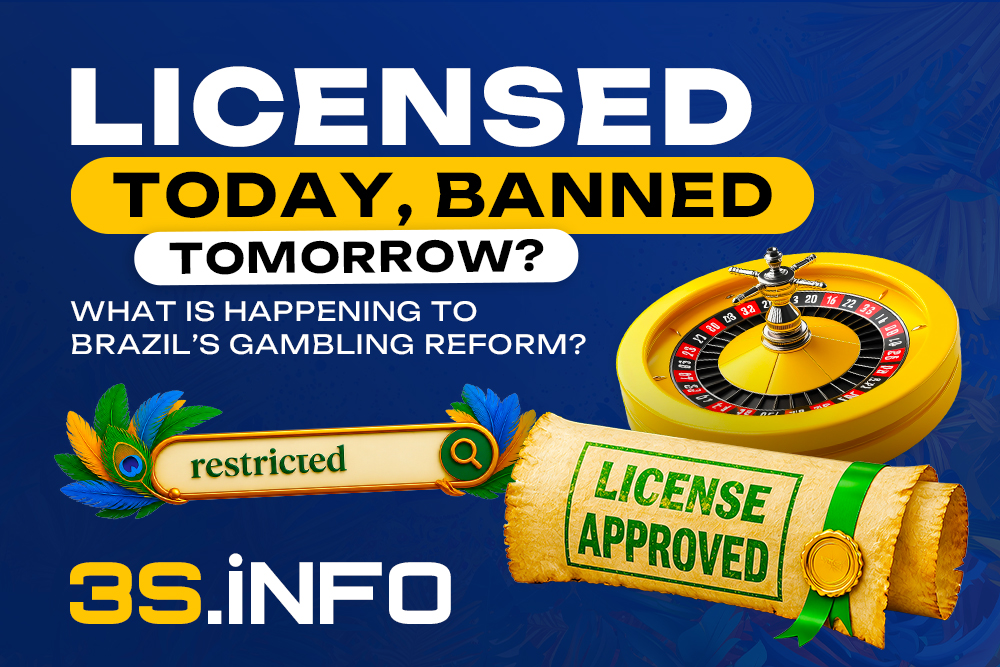
Brazil was meant to become one of global iGaming's flagship success stories. A vast population, mature payment infrastructure, the popularity of sports, and long-standing demand made the country an almost perfect candidate for moving from a gray market to a regulated model. Operators were invited to secure licenses, establish local legal entities, integrate mandatory control systems, and begin paying taxes. In return, the industry expected clear rules and the ability to operate legally in one of the largest markets in Latin America.
Yet the fully regulated market only went live on January 1, 2025, and by 2026 the political debate had moved well beyond routine regulatory fine-tuning. Congress is weighing strict restrictions on advertising and sports sponsorship. A separate bill proposes banning online casinos once again while keeping bets on real sporting events legal. In parallel, the administration of President Luiz Inácio Lula da Silva is discussing the possibility of pushing through some of the changes via a provisional measure that could take effect immediately upon publication.
None of these scenarios can yet be called final. But the mere fact that they are under discussion is already reshaping the market. Brazil's reform is morphing from a story of legalization into a stress test of the political resilience of a young regulated system.
3S.INFO takes a detailed look at the conflict between player protection and the economics of a licensed market. A closer examination reveals how shrinking the legal offering may not eliminate demand but instead push part of the audience back to offshore platforms. The core problem is the absence of "regulatory memory": the state can change the rules before investments pay off, calling into question trust in Brazilian regulation as a whole.
How Brazil Arrived at a Regulated Market
Fixed-odds betting was formally legalized in Brazil back in 2018, yet no full-fledged licensing and oversight mechanism was created at the time. For several years, operators were able to serve the Brazilian audience through offshore entities without holding a local license in its modern sense.
Law No. 14.790, passed in December 2023, was meant to close that transitional period. It laid the foundation for regulating fixed-odds betting, including wagers on real sporting events and certain types of online games. The Ministry of Finance, through the Secretariat of Prizes and Betting (SPA), was empowered to issue licenses, supervise operators, and impose sanctions.
To enter the federal market, companies had to pay 30 million Brazilian reais for a five-year license, establish a local legal entity, and meet requirements covering ownership structure, technical infrastructure, customer identification, advertising, financial monitoring, and player protection. The license allowed the use of up to three brands.
Brazil thus offered businesses a classic regulatory bargain: operators pay for entry, localize, disclose their ownership structure, and take on costly obligations, while the state creates a legal market where licensed companies can compete with a clear set of products.
For major international groups, such expenses looked justified. Brazil is home to more than 200 million people, one of the region's most active digital markets, and a country where Pix has turned instant payments into an everyday mass practice. Here, one could build not an experimental project, but a full-fledged national business.
However, investment calculations rested not only on audience size. They factored in the combination of sportsbook and online casino, the ability to advertise a licensed brand, sign sponsorship deals, and convert a sports audience into higher-margin gaming verticals. Now each of these elements has been called into political question.
- Brazil has become one of the world's most prominent and fastest-growing iGaming markets, combining a vast audience, a deep-rooted football culture, mobile-first behavior, and federal regulation of online betting and gaming. For a full breakdown of the laws, regulatory rules, and licensed brands, see the Brazil iGaming Overview.
A Regulatory Framework Still Taking Shape
The first year of a regulated market rarely passes without changes. The state has to refine technical requirements, close loopholes, fight illegal sites, and verify whether player protection mechanisms actually work in practice. So tightening the rules does not, in itself, mean the reform has failed.
Brazil's case stands out for the scale of the proposed changes. The debate is no longer just about deposit limits, additional customer checks, or the wording of advertising warnings. An almost complete restriction of marketing communications, a ban on sports sponsorship, and the possible exclusion of online casinos from the list of legal products are now on the table.
In other words, the state is discussing a change to the very economic model of the market, shortly after selling businesses the right to operate within that model.
This is especially important for assessing regulatory risk. An operator can budget in advance for higher taxes, responsible gaming costs, or new reporting requirements. It is far harder to prepare for a situation where a significant part of the permitted product range may be banned before the initial investment has paid off.
- For several years now, Ontario has served as one of the most prominent examples for the global iGaming industry. The province did not settle for a formal opening of a regulated market. It managed to steer a significant share of players toward licensed operators and make the legal model competitive. On 3S.INFO, we examine which decisions produced that effect, why regulators, operators, and affiliates in other GEOs study Ontario's experience, and what lessons can be applied when launching or reforming gambling markets elsewhere.
PL 2.470/2026: The Legal Market May Lose Its Public Voice
Details: Official record of PL 2.470/2026.
One of the key initiatives is Bill PL 2.470/2026, introduced by Senator Damares Alves and a group of co-sponsors. It focuses on protecting mental health, consumers, and family finances in the betting and online gaming sector.
In early September 2026, the Senate Committee on Science, Technology, Innovation, and IT approved a revised version of the bill and backed a request for expedited consideration. However, this does not yet mean the provisions have entered into force: the bill continues its legislative path and may still be amended. Its current status must be distinguished from regulation already in effect.
The bill foresees sweeping restrictions on both direct and indirect advertising of betting and online gaming. These could reach television, radio, digital platforms, operators' own channels, influencers, and other communication formats. A separate section deals with sponsorship of sports clubs, competitions, broadcasts, cultural and social projects. A transition period is built in to adapt existing sponsorship agreements.
The document also curbs incentive mechanics, including certain bonuses and cashback, and proposes classifying gaming products by risk level. The assessment could factor in round speed, the potential for continuous repeat betting, the use of random or algorithmic outcomes, near-miss mechanics, and other elements capable of amplifying compulsive behavior.
This means the bill could affect not only communication, but also the product catalog. Even without a direct ban on online casinos, individual games may become unavailable if they are deemed excessively risky.
From a public health standpoint, the logic is clear. Mass advertising normalizes betting, sports sponsorship ties gambling to fans' emotional loyalty, and fast games allow a large number of bets to be placed in a short span of time. The problem lies in choosing the scale of the response: should a risk assessment lead to targeted restrictions or to the effective disappearance of the licensed product from the public space?
For a regulated market, advertising serves more than a commercial function. It helps a player tell a legal brand apart from a site that holds no Brazilian license. If licensed companies lose their main communication channels, offshore operators will not necessarily vanish along with them. They will keep drawing audiences through search results, social media, messengers, mirror sites, influencers, and affiliate websites that sit beyond the effective reach of Brazilian authorities.
As a result, the only clearly visible offering may end up being the illegal one.
PL 2.258/2026: Keep Sportsbook, Ban Casino
Details: Official record of PL 2.258/2026.
An even more radical change is set out in Bill PL 2.258/2026, introduced by Congressman Paulo Pimenta. The document prohibits the operation, offering, and advertising of gambling where the outcome is generated by an electronic system or algorithm. At the same time, it repeals the provision of the 2023 law that allowed online games to be included in the regulated model.
In practice, this primarily targets online slots and other digital casino products. Fixed-odds bets on real sporting events are meant to remain legal. The bill is under consideration in the Chamber of Deputies and is not yet law in force.
The political symbol of this initiative has become the so-called Jogo do Tigrinho, a catch-all term that public debate links to fast mobile slots, aggressive promotion, and losses among financially vulnerable users. The problem is that, in the popular imagination, the line between specific controversial apps, illegal platforms, and licensed casino products has all but disappeared.
The bill proposes to restore that line in the simplest way possible: keep sports betting and remove algorithmic casino games altogether.
For operators, however, sportsbook and casino are not two independent businesses. Sports betting draws a mass audience, but it can carry relatively low margins, high bonus costs, and significant marketing expenses. Casino often delivers higher returns and helps recoup the cost of customer acquisition. It is precisely this combination of verticals that usually underpins the financial model of a universal betting platform.
If casino is banned, the right to operate will formally remain, but the economics of the license already purchased may change dramatically. Companies that were counting on cross-sell, acquiring users through football and then monetizing them in other gaming categories, will be especially vulnerable.
A Provisional Measure Adds a New Layer of Uncertainty to the Market
In September, it emerged that the Lula administration is weighing tighter regulation via a medida provisória, a presidential provisional measure. Unlike an ordinary bill, such a measure takes effect immediately upon publication, though it must subsequently be reviewed by the National Congress.
Among the options under discussion are additional advertising restrictions and a ban on online casinos while keeping sports betting intact. At the time of writing, the final text has not been published, so it would be premature to speak of a decided outcome. Even so, the appearance of such a mechanism in the debate noticeably raises short-term risk: changes could, in theory, begin before the market completes a full parliamentary cycle.
Previously, an operator could track the progress of bills, take part in public hearings, and prepare for several rounds of voting. Now, alongside the ordinary legislative process, a scenario of far swifter intervention has emerged.
For an investor, this changes not so much the probability of a particular ban as the planning horizon. An asset's value is determined by expected cash flows, and those depend on the list of permitted products, the tax burden, and the available acquisition channels. When any of these parameters can shift almost overnight, a substantial political risk discount has to be built into the investment model.
Why Attitudes Toward Betting Shifted So Quickly
The main reason is the gap between the legal and public logic of the reform.
From the regulator's standpoint, legalization was supposed to channel existing demand into a controlled system. Operators undergo screening, identify players, connect to monitoring, comply with anti-money laundering requirements, and pay taxes. The state gains tools it never had in the gray market.
From the ordinary citizen's perspective, the rollout of regulation looked different. Betting brands became conspicuous in football broadcasts, on club kits, across social media, and through influencers. At the same time, the public agenda filled with stories of addiction, debt, squandered welfare payments, and aggressive promotion of mobile games.
The state expected to normalize control, while the public saw the normalization of gambling itself.
Let us add electoral politics to the mix. A hardline stance on betting appeals to several groups at once: religious and conservative voters, consumer advocates, public health specialists, and citizens worried about the family budget. In such an environment, a call to ban "Tigrinho" is politically easier to make than a proposal to spend years refining risk models, analyzing player behavior, and gradually tuning oversight.
So the discussion rapidly pivots from "how do we improve regulation?" to "why did we allow this at all?"
Who Pays for a Partial Rollback
Operators will feel the fallout first. They will have to recalculate their financial models separately for sportsbook and casino, assess the viability of the business without mass advertising, and revisit the value of sponsorship deals already signed. Some international groups will be able to accept a longer payback period. Others will have to cut marketing, trim the product lineup, or even scale back their presence in the country.
The second layer is the sports industry. Betting brands have become a significant category of sponsors for Brazilian clubs, tournaments, and broadcasts. A ban will not zero out contracts overnight if a transition period is retained, but clubs must already factor in that an entire category of advertisers could vanish in the next round of negotiations. Replacing that money is not guaranteed, especially for teams outside the upper tier of Brazilian football.
For affiliates, the restrictions translate into a narrower pool of legal marketing inventory. Influencer integrations, paid campaigns, bonus pages, and branded content will all come under pressure. SEO and informational products may become more valuable, but only if the rules do not start treating any commercial communication as prohibited promotion.
Payment companies will face a different paradox. Shrinking the regulated market does not automatically reduce the volume of illegal operations. Banks, acquirers, and PSPs will have to identify payments to offshore platforms more precisely, monitor intermediaries, and respond quickly to lists of banned recipients. The further a transaction drifts from a transparent licensed operator, the harder monitoring becomes.
Finally, the consequences will reach B2B providers: suppliers of platforms, games, KYC, anti-fraud, analytics, and responsible gaming solutions. Some of them have already invested in local certification, integrations, and teams. If the range of legal products is sharply reduced, the potential market for these solutions will shrink along with it.
Banning a Product Does Not Erase Demand
Proponents of tough measures rightly point out that holding a license does not make a product safe. Oversight can reduce harm, but it does not eliminate addiction, impulsive betting, and financial losses. If certain mechanics systematically generate excessive risk, the state is not obliged to preserve them simply because businesses have already invested money.
But there is a flip side: banning a regulated offering does not destroy consumer demand.
Brazilians played on foreign sites long before licensing launched. If online casinos are outlawed once again, part of the audience will stop playing. Another part will migrate to offshore platforms that do not check customers' financial vulnerability, are not connected to the national self-exclusion system, and are under no obligation to follow Brazilian rules on paying out winnings.
The more attractive the product and the weaker the enforcement, the higher the likelihood of such a shift.
The effectiveness of a ban will therefore depend not on the wording of the law, but on the state's ability to control the entire access chain: domains and apps, search results, social media, affiliates, influencers, payments, and technology providers. Without that, the regulated market will shrink faster than the illegal one.
For player protection, such an outcome may prove worse than the original model. A licensed operator, at least, sits inside a system of sanctions and reporting. An offshore site may observe no limits, no advertising requirements, and no responsible gaming rules at all.
iGaming in Brazil 2027: Three Possible Scenarios
- The first scenario is strict tightening without a full ban on online casinos. Brazil restricts advertising and sponsorship, introduces tougher product assessment, strengthens self-exclusion, and bans certain high-risk mechanics. Casino remains part of the legal market, but operates within a far narrower corridor. This is the most straightforward compromise between consumer protection and preserving a regulated system.
- The second scenario is a split market. Sports betting stays legal, while algorithmic casino games are banned. In this case, the state retains part of its tax base and oversight infrastructure, but operators lose a significant share of potential revenue. Consolidation, reduced marketing, and a revaluation of Brazilian assets become likely. At the same time, the risk grows that the casino audience drifts back to offshore.
- The third scenario is further political escalation. If the crackdown on betting keeps delivering electoral gains, restrictions may gradually extend beyond online casinos. First, advertising disappears; then individual products; then the very permissibility of remote betting comes up for debate. A full ban is not yet a settled outcome of the reform, but the market is obliged to factor in the direction of political travel.
What Companies Should Be Doing Now
Operators should recalculate the economics of their Brazilian business without assuming the current product model will hold. They need separate P&Ls for sportsbook, casino, and the combined platform, along with scenarios involving a ban on bonuses, mass advertising, and sports sponsorship.
In existing contracts with clubs, media, and affiliates, it is essential to review clauses on legislative change, early termination, and the allocation of regulatory risk. A long-term agreement without such a mechanism can turn into an obligation to pay for a channel the operator is no longer allowed to use.
Dependence on games that could fall into the high-risk category should also be reduced, and an evidentiary basis prepared around their design: round speed, limits, user disclosure, the availability of a pause, and the link to responsible gaming tools.
However, legal groundwork alone is not enough. The industry loses the public debate if it speaks only of taxes, licenses, and jobs. It must demonstrate the practical difference between a regulated and an illegal operator: where a player turns when a dispute arises, who controls payouts, how self-exclusion works, what data the regulator receives, and what sanctions are possible for violations.
If that difference remains invisible, society will struggle to understand why a regulated online casino is better than a banned site. To the average voter, both products look the same, and the argument about protecting the legal market starts to sound like protecting corporate revenue.
The Main Risk Is Not a Ban, but the Absence of Regulatory Memory
Brazil has every right to revisit its gambling policy. A young market should not preserve harmful mechanics simply because they were once permitted. If the data reveals significant social harm, the state is obliged to respond.
Yet the quality of regulation is not defined by the harshness of the response alone. It depends on consistency, the evidence base, and the ability to account for the consequences of one's own decisions.
The state first offered businesses a costly legalization model. Companies paid for licenses, set up local entities, implemented KYC and financial monitoring, signed contracts, and built out ROI plans. If, after all that, the permitted product is banned without a full assessment of the alternatives, the question shifts from gambling to trust in Brazilian regulation as a whole.
A license cannot guarantee that the rules will never change. But it should signify that the state honors the terms on which it invited businesses into the market and does not alter them without a clear transition period, data, and an assessment of the impact on the illegal sector.
That is precisely why the Brazilian case matters far beyond the country's borders. It shows that launching a regulated market is not the final point of reform. The real test begins later, when public discontent grows, the political cycle accelerates, and a ban once again becomes the simplest answer.
If Brazil finds a balance between reducing harm and preserving a controlled offering, it can strengthen its young system. But if the reform moves backward before it has had time to work, the market will receive a different signal: a license grants the right to operate today, but does not guarantee that tomorrow the license will still cover the product it was purchased for.