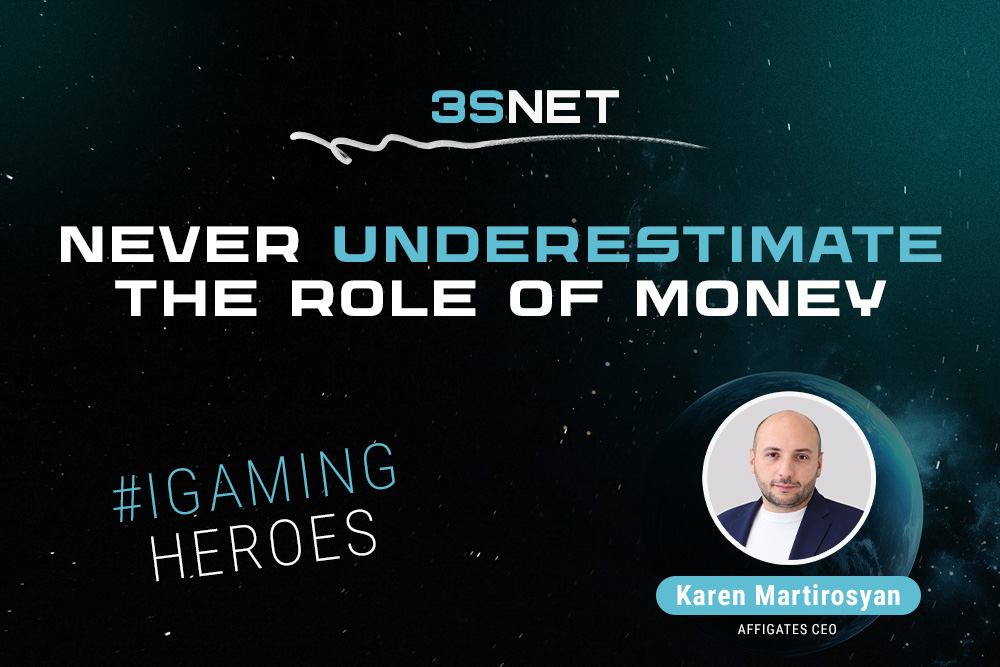
In a new interview for iGaming Heroes, Karen Martirosyan, CEO of the Affigates platform, talks about moving from finance and audit into gambling, building a career from Product Owner to CEO, and the ins and outs of managing fast-growing teams. How to build a data-driven approach without drowning in metrics, retain top specialists, automate affiliate marketing, and evaluate partners not just by FTD but by the long-term value of their traffic. The interview also covers management mistakes, the role of intuition and numbers when launching new ventures, and the challenges a CEO faces. Find it all on 3S.INFO!
- Your route into iGaming began far from iGaming: audit at Grant Thornton, banking, an MBA in finance, even a CFO role at a restaurant. How does someone with that background end up in a gambling product? Is that a conscious pivot or a lucky coincidence?
More a lucky coincidence that turned into a conscious pivot. I never set out to build a career specifically in iGaming, but my background in finance, audit, and operational management gave me a solid foundation that really came into its own here.
This field brings together what feels professionally close to me: numbers, speed, competition, and the chance to see the direct impact of my decisions. Over time, it became less about the industry and more about the environment where I want to build a business, make calls, and watch them play out in real time.
- You came into the industry with a finance and audit mindset, a habit of counting every penny. What surprised you most about how iGaming treats numbers and economics when you first entered?
What surprised me was not the number of figures, but the speed at which they change. In a classic financial business, you often analyze results after the fact: a month, a quarter, a year. In iGaming, the economics are practically live. You change the product, the marketing mechanics, or the user journey, and you see the impact on user behavior and financial results fairly quickly.
But there is a flip side. A large volume of data sometimes creates the illusion that a company is data-driven simply because it has plenty of reports. To me, being data-driven is not about having a thousand metrics. It is about understanding which handful of numbers actually explain the state of the business and what decisions follow from them.
- A striking number of the strongest iGaming teams have come out of Armenia. What makes that environment so good at preparing people for the industry, and did it help you personally?
I think Armenia has hit on a very fortunate mix of a strong technical school and an entrepreneurial mindset. Our market is small, so companies that want to grow seriously are forced to think globally almost from day one. You cannot survive for long within a local market alone; you have to work across different countries, cultures, regulations, and business models.
On top of that, a fairly tight-knit professional community has formed here. People move between products, launch their own companies, and come back with new experience. Knowledge circulates through the ecosystem very quickly. For me personally, this environment gave me the chance to work on large-scale international products alongside very strong specialists quite early on.
- At BetConstruct, you rose from Product Owner to VP over six years, and then became CEO of Affigates. When did you first feel that you had stopped being a specialist and become a leader, and what was the hardest part of that transition?
Probably the moment I realized that my results were no longer defined by what I could do myself, but by what the team could achieve. As a specialist, you get used to solving problems with your own hands, and that gives you a sense of control. But as the team grows, that approach starts to hold you back: if every important decision has to pass through you, you have not built a team, you have built a queue to yourself. The hardest part was learning to hand over not just tasks, but responsibility, and to let people make their own calls, even if they differed from mine and sometimes went wrong. Today, I see one of a leader's main jobs as not being the strongest specialist in the room, but creating an environment where strong specialists can make decisions without the leader constantly looking over their shoulder.
- iGaming is a high-turnover industry, where people readily move on to whoever pays more. How do you hold on to strong people, and what, in your experience, keeps someone more firmly than money?
Never underestimate the role of money. If someone feels the market values them far higher, no corporate culture will make up for that for long. But beyond a certain level, money stops being the sole factor.
What keeps strong people around is the scale of the challenge, trust, the ability to shape decisions, and a sense of their own growth.
I try to build teams where a person understands not only what they need to do, but also why. When a strong specialist sees the link between their decision and the business outcome, has room for autonomy, and knows that a year from now they will be stronger here than they are today, that is a very compelling reason to stay.
- Over your career, you have surely made decisions that did not work out. Which mistake taught you the most, and what exactly did you change in yourself after it?
One mistake I definitely made at various points in my career was trying too long to bring a solution to a perfect state before testing it against the market. It is easy to fall into that trap when you have a product mindset: the team sees the big picture, ideas multiply, and the urge is to build the full solution right away. But the market can disprove in a few weeks what seemed obvious inside the company for months.
Over time, my approach changed: prove the value first, scale later. I became far more comfortable with version 1.0 and far more demanding about how quickly we get feedback.
To me today, a bad decision is not necessarily one that turned out to be wrong. Far worse is a decision we could have tested in a month but ended up testing for a year.
- You have been in the CEO seat for less than a year. What turned out to be completely different from how you imagined it from the outside, when you were a top manager but not yet the first person?
Probably the density of decisions. As a top manager, you are already responsible for a serious chunk of the business, but you still have a certain boundary of responsibility. In the CEO seat, that boundary practically disappears. Product, sales, team, finance, partnerships, reputation — at some point, completely different issues converge in a single point. And a CEO cannot be the top specialist in every one of them. So the most important change for me has been the quality of prioritization. The question is no longer just which decision is right. You need to understand which decision genuinely requires your involvement right now, and where the team should move forward on its own.
In the end, the CEO role has come to be far more about choosing your focus and level of involvement than about trying to keep everything in the company under control.
- You do not just work in affiliate marketing; you build tools for it. What do specialists who have worked "hands-on" in affiliate management for years most often fail to notice? What do you notice from the product side that they might miss?
When you work inside an operational process every day, it is very easy to get used to its inefficiency. Spreadsheets, manual reconciliations, dozens of messages, repetitive checks can all come to feel like a natural part of affiliate management. From the product side, you start asking a different question: why should a person be spending time on this at all?
To me, good technology should not replace the affiliate manager. It should strip out of their work the parts where human judgment adds no extra value: the routine, the repetitive operations, some of the analysis and control. That way, a person's time stays for what is genuinely hard to automate: negotiations, relationships, strategy, and understanding the partner.
- Many operators still evaluate the affiliate channel primarily by the number of FTDs. How well does that approach reflect a partner's real value, and which numbers do you look at first?
FTD is an important metric, but on its own it mainly speaks to a partner's ability to bring a user to the first target action. It says nothing yet about how good the audience they brought really is.
Two partners can deliver the same number of FTDs and have completely different value for the business. So I prefer to look further along the user lifecycle: retention, repeat activity, LTV, cost of acquisition, payback, traffic quality, and the overall unit economics per affiliate.
The affiliate channel becomes genuinely manageable when we stop asking only "how many users did they bring?" and start asking "what long-term value did they create?"
- You have a head for numbers. When you decide whether to take on a new direction, what tips the scales: the numbers on paper or a gut feeling that it will take off?
I would not set those two against each other. Intuition is often what lets you spot an opportunity before there is enough data to support it, especially when it comes to a new market or a new product. If you wait for the moment when Excel can prove the success of a new idea, someone else may have already brought it to life.
But to me, intuition is the right to start testing a hypothesis, not the right to fund it indefinitely. So at first there may be a gut feeling that there is an opportunity here. Then I want to get numbers as fast as possible, numbers that either confirm it or make me drop it.
Good intuition helps you choose what to test. Good numbers help you decide what to scale.
Want to become iGaming's next rising star? Drop us a line right now, and we will work out the details in no time.
Follow the 3SNET Telegram channel, where exclusive features and interviews with the industry's top experts land first.
- Quickfire
The most underrated leadership skill in iGaming?
The ability to prioritize well. In a fast-growing business, there are always more good ideas than resources.
What matters more on a team: talent or reliability?
Reliability. But the ideal combination is talented people you can count on.
The worst management advice you have ever received?
"If you want something done right, do it yourself." For a specialist, that sometimes works. For a leader, it is almost always a trap.
One thing you would never delegate?
Responsibility for the final outcome. Decisions and execution can be delegated. A leader's responsibility cannot.
Numbers or intuition?
Intuition to figure out where to look. Numbers to decide where to go.
If you could change one thing in the affiliate industry overnight, what would it be?
I would shift the focus from traffic volume to its real value. Less of a race for quantity, more transparency, quality, and long-term economics.