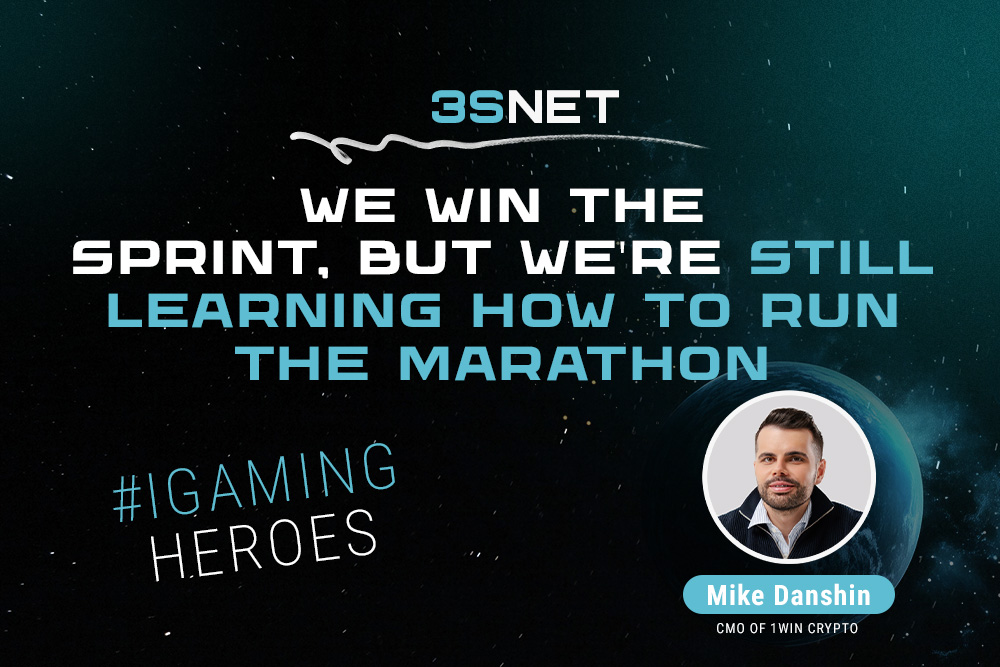
Today on 3S.INFO, head over to the iGaming Heroes section for an honest conversation about how the market is shifting at the crossroads of betting, crypto, and global GEOs. The interview covers the differences between the CIS, Latin American, Asian, and Indian markets, the strengths and weaknesses of the "Russian school" of iGaming, the industry's skepticism toward prediction markets, the similarities and differences between crypto natives and classic gamblers, as well as a personal take on Limassol as an "iGaming island," where locals and expats coexist side by side. Meet Mike Danshin, CMO of 1win Crypto.
- Tell us about your career path. Was it always a conscious plan, or did you just go where it felt interesting?
More conscious, but the logic behind it isn't really career-driven. It's human. I have an agile mindset. I enjoy trying new things, and I love it when a skill from one field unexpectedly proves useful in another. Discipline in sports translates into discipline at work. At the intersection of different domains, something fresh always emerges, and that's great for building neural connections.
If you look at my journey, there were no sharp turns. All my moves have stayed within iGaming. What changed was the side of the business: affiliate, land‑based casino, product, agency. It felt like I was piecing together a puzzle, one fragment at a time. And now that gives me the ability to view the industry from multiple angles and understand what drives very different types of market players. A couple of pieces are still missing (payment systems and game providers) but honestly, I don't see myself on the payment side.
- You've worked on projects with very different audiences and marketing approaches. Based on your experience, what remains unchanged regardless of the market or product, and what do you have to relearn almost from scratch?
What stays the same is economics and psychology. A person who comes to play is essentially the same everywhere. They want excitement, easy entry, and the feeling of being part of something. The funnel itself, acquisition, and payback work the same way from the CIS to LatAm. And right now, gambling is spilling beyond casinos. Gambling mechanics are being used in wallets, mini‑games, and prediction markets. Almost everything around us is becoming gamified.
What you have to relearn every time is channels and GEO specifics. LatAm, in terms of mentality, is surprisingly close to the CIS, and influencer marketing works great there. Asia is a different set of combinations and a different rhythm. India is a whole separate planet. You can't treat it as one country. There are dozens of states, languages, and habits, lots of trust issues with affiliates and communication. So, without strong local presence, there's nothing to do there. This, the GEO picture and the channels that actually work, you basically rebuild from scratch for each market.
- There's a feeling that "The House in Curaçao" ("Домик в Кюрасао") isn't just a channel, but a way of thinking out loud. Do you write for yourself or for your audience?
Honestly, first and foremost for myself. It's a way to organize my thinking. I listen to conference talks, catch an idea, and grow it through text until it becomes clear. But I only publish what can stand up to a debate with a professional audience: affiliates, operators, marketers, people who can spot a stretch right away.
So it's both a diary and a test at the same time. The channel is fundamentally personal and independent, and I keep some conclusions to myself if they're operator‑sensitive. What goes public is a breakdown of mechanics, written in the first person, with an invitation to argue in the comments. For me, the argument itself is the main test. If a thesis can hold its ground against readers, it means it's alive.
- Name a decision in your career that seemed right at the time but turned out to be a mistake. What did you learn from it?
The most telling one was overestimating Telegram as a global platform. When we were pushing a token and a Telegram bot, it felt like the sky was the limit: tens of millions of active users, and this sense that it would be the same everywhere. It's a very understandable trap. For us in the CIS, Telegram is the most convenient messenger and the primary source of information, and you automatically assume it's the same worldwide.
But when you start scaling into other GEOs, you hit a wall. Based on the numbers we looked at, across all of LatAm, Telegram channels are read by a negligibly small number of people. One of the largest active channels in a huge country like Turkey turned out to have a relatively small subscriber base. The growth you were banking on simply isn't there. On top of that came the bans and the overall shift of the ecosystem to TON. At the time, the bet paid off, but the prospects we initially envisioned never materialized, and judging by the market, they probably never will.
The lesson is simple and uncomfortable: you can't extrapolate your own bubble to the rest of the world. What seems obvious to you and your circle might not even exist in another GEO. Now, I test any big bet on a foreign market first, rather than relying on my own intuition.
- Crypto marketing in iGaming is a space full of hype and promises. Have you ever promoted something you didn't fully believe in yourself? How do you deal with that?
Yes, I have. The most common case is promotions and bonuses. I regularly test products on myself. I find it interesting, and sometimes you can immediately tell that a particular offer doesn't resonate with you as a player. But it's already live, with a budget behind it, ready‑made creatives, and established funnels, and turning it around mid‑flight is difficult.
For me, this isn't a matter of belief, but a matter of testing intuition. What you can actually do is give the promotion a small budget, pull the numbers, benchmark it against the market, confirm that it converts poorly, and quickly communicate the findings to the teams so they can adjust. So a personal feeling is just a hypothesis, while the real answer comes from measurement. I'm at peace with that because my job isn't to guess with my heart, but to test quickly and not drag weak performers any further.
- You've observed the Russian betting market from the inside, from media to a major operator. In your view, where is the Russian school of iGaming genuinely stronger than the Western one, and where is it hopelessly lagging behind?
Where we're strongest in the CIS school is flexibility and speed of decision‑making. We know how to test hypotheses quickly, roll out combinations, enter new GEOs, and change course without getting bogged down in approvals. This is performance marketing thinking in its purest form: spot a signal, test it, move on. It's precisely because of this that we often end up being first in places where large Western structures are still putting a team together.
Where we fall behind is building long‑term business processes. The West is stronger where you need to build for the long haul: systematic processes, sustainable structures, working on a horizon of years rather than sprints. Our speed often comes at the cost of systemization, and what fires fast becomes harder to scale and sustain later. So in short: we win the sprint, but we're still learning how to run the marathon.
- Prediction markets: you've covered them in your channel. Why is the classic betting sector still brushing them off? Is it ignorance or fear?
Neither. It's sobriety. The leaders of the classical industry themselves have already said that, in terms of economics, prediction markets are essentially a betting exchange, which Europe has known about for a quarter of a century and has long regulated strictly. When the main takeaway on stage boils down to "Betfair was already around twenty‑five years ago," the ceiling is clear from the start.
Then there's the mechanism we've already seen in poker. The model relies on a constant inflow of fresh money from amateurs, and amateurs lose over the long run. The World Championship will bring the largest influx of newcomers in the history of these platforms, and they'll be the ones facing the toughest odds. Information asymmetry is high there. On the other side of the table are market makers, bots, and those with better data. In poker, the boom was cut short by regulatory blows. Betfair introduced the Premium Charge back in the day because winning professionals were draining liquidity and scaring off beginners. So it's not about fear or misunderstanding. The European market has simply seen this movie before and knows how it ends.
- More on this: what exactly is a prediction market? Let's break down where all the hype came from, why people are drawn to it, and why this industry keeps finding itself at the center of scandals and legal disputes.
- You work at the intersection of two audiences: crypto natives and classic gamblers. Are they fundamentally different people, or is it just different habits in the same people?
More and more, they're the same people with different habits. Players have become multi-brand. The average number of products per person has grown noticeably, and almost everyone plays across several platforms simultaneously. The only segment that remains strictly loyal to a single brand is a narrow VIP group.
The difference isn't in the nature of the person, but in their expectations of the experience. The generation that grew up on Web3 values seamlessness: minimum barriers, extra authorizations, or loading times. The flow needs to feel native. They also value horizontality: transparency, community, and the ability to engage with the brand on equal footing in social media and chats. A classic gambler is more relaxed about all of this. But the line is blurring fast. Casino elements are spreading everywhere. The industry is becoming more public and legitimate, sponsoring not only sports but also music festivals and signing artists from adjacent niches. So I wouldn't talk about two tribes, but rather a single spectrum of habits that's converging.
- Let's continue the topic! Expert opinion from 3SNET's Alex Miller: "Do casinos and players live in different realities?"
- You live in Limassol, like half of the iGaming industry. Does it feel like a community, or like a corporate campus where everyone pretends they're not competing?
First, about the city itself, because this is a strong personal feeling. For me, Limassol is the island from GTA San Andreas. As a kid, I played San Andreas endlessly (Vice City, by the way, I never really liked), and there was always this annoying feeling that the developers had cut corners and didn't make the full city, like how could the map be that small? Then you come here, drive the same routes to the same spots every day, and you get this flashback: turns out nobody was cutting corners. It's just that someone actually lives in Limassol every day on a map the size of San Andreas.
As for competition, it's a mix of two almost non‑overlapping universes. There are the locals, who live their own lives, and there are the expats, who live theirs. The level and the very nature of competition are vastly different between them, and it's surprising how little these two worlds intersect. So it's not a corporate campus, and it's not one warm, unified community. It's parallel layers sharing one island.
- If you had to leave iGaming tomorrow, what would you do? And is there anything in the industry you wouldn't want to take with you?
I definitely don't want to leave. But if I imagine it, I'd go into something where my expertise and genuine interest overlap, because the best results always come from that intersection, and you can't fake genuine interest. For me, that's sports, fitness, well-being, and more broadly, the themes of productivity and personal development. The most obvious but honest answer would be a sports app.
What I wouldn't take with me is the culture of gossip channels. In iGaming, there's a whole layer of people living on that content, and I think it's a specific feature of the CIS scene. I've hardly seen anything like it in the West. Gossip exists in any entertainment industry where winner takes all, but nowhere else does it consume so much attention as it does here. That background noise I'd leave behind.
Stop standing still! Level up in iGaming! Ready for a conversation? Reach out to us, and we'll quickly prepare tailored questions and discuss your case.
Stay ahead of the curve! Subscribe to our Telegram channel, where we share what's not publicly available: leader forecasts and fresh analytics.
Quick answers
— One person in the industry you learn from quietly, without telling them?
For a long time, it was Dima Sergeev. His channel, from the very first posts, is the foundation of iGaming. You could honestly reread it from the beginning. These days, if anything, it's more like iGaming CPO, but he's almost faceless, so it's not quite the same format. But if we're talking about a long stretch and a name, then Dima.
— The most overhyped term in Web3 right now?
Here I'd separate the term itself from the expectations around it. I don't consider Web3 a hollow concept. I wouldn't call prediction markets an overblown term either, but the expectations around them are definitely inflated. This thing has a ceiling, and I'm more inclined to expect a decline than a new wave. So it's not the term that's overhyped. It's the belief that this is a new asset class.
— A token as a product: is it marketing or infrastructure?
In iGaming, it's more about marketing. It's an acquisition channel. The iGaming infrastructure is still largely Web2, from classic games to slots, where Pragmatic Play has held the top spot for years. So a token works primarily for acquisition, and only a few are building a fully on‑chain infrastructure.
— What kills a crypto project faster: a bad product or a bad community?
As a marketer, I'd blame the weak product. I wouldn't divide communities into good and bad/ That's more of a judgment call. They can be toxic or charged with enthusiasm. You can mishandle a community or neglect it, but even then, sometimes opinion leaders emerge on their own and take the initiative. A weak product, on the other hand, won't fix itself, and no community can carry it in the long run.
— What did you miss in classic PR that crypto marketing has in abundance?
Clear, measurable metrics and data‑driven decision‑making. In classic PR, that was sorely lacking. In crypto, there's an abundance of it: almost everything here is measurable.