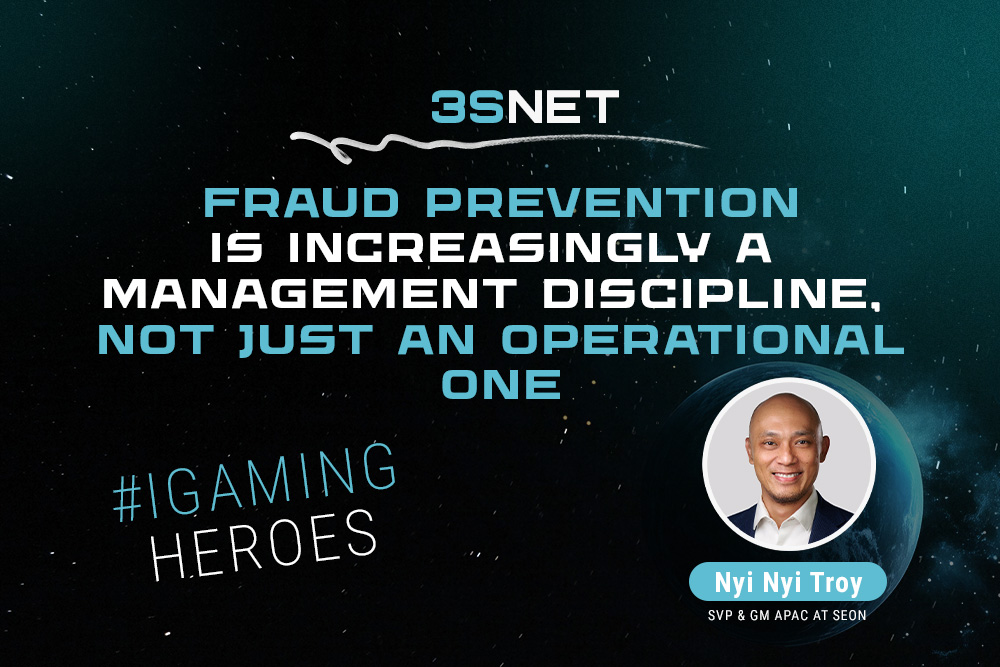
The fraudster's journey has evolved from amateur attempts to patient syndicates managing multi-account networks and relationship-driven investment scams. Meanwhile, the industry faces severe pain points: rising false positives and the flawed strategy of scaling manual review instead of deploying systemic AI. How to you sell anti-fraud solutions in high-trust societies? What architectural framework is required to uncover hidden connections between accounts? And why is tackling bonus abuse and account takeovers in isolation no longer viable without cross-industry collaboration between operators, regulators, and payment providers? Find the answers in the latest iGaming Heroes interview on 3S.INFO. Today, Nyi Nyi Troy, SVP & GM of APAC at the international anti-fraud platform SEON, shares his strategic insights.
- What is SEON? It is an international anti‑fraud and AML platform that helps digital businesses detect fraud, assess user risk, and meet KYC/AML requirements without adding unnecessary friction to the user journey. Its clients and target industries include fintech, banking, e‑commerce, marketplaces, and iGaming operators. Founded in 2017 in Budapest, SEON is now headquartered in Austin, with additional offices in London, Budapest, and Singapore.
- You studied engineering at King's College London. How did you end up in fraud prevention? Was it a deliberate career choice or something you stumbled into?
A bit of both. Engineering gave me the analytical instinct — thinking in signals, patterns, what's normal versus what's worth chasing. But I was drawn less to sitting behind the technology and more to being in front of the business, explaining why it matters and closing the gap between what the system does and what the customer actually needs. Fraud prevention is where those two pulls met — technical enough to reward the engineering instinct, but a category where the person representing the technology matters as much as the technology itself. That combination is what's kept me here for two decades, and it's why I ended up leading the regional business rather than staying purely technical.
- You have worked at Forter, TeleSign, BPC, and now SEON — different companies tackling similar challenges from different angles. What were you looking for with each move?
Each move followed the same pull — staying close to the technology, but on the revenue-facing side, in markets where the fraud problem looked different each time. It goes back to 2008, when I was introduced to digital security in financial services at Gemalto (now Thales). Experian was my first work in digital identity risk assessment, and TeleSign moved me into telecom-layer identity signals — phone numbers, devices, the earliest points where you can infer risk before a transaction happens. Forter widened that into behavioral and device signals at the point of purchase, and put me directly in front of customers. BPC took me into payments at banking scale — slower-moving, more regulated, higher stakes per decision. SEON, and building out APAC, is where those threads converge — fraud and AML increasingly read off the same data rather than as separate disciplines, and this region is where that's happening fastest.
- You have spent nearly 20 years in an industry where your job revolves around deception and fraud. How has that shaped you as a person?
It's made me comfortable holding two things at once — assuming good
faith in people while building systems that don't rely on it. What hasn't changed is the belief that most people are honest; the job is protecting that majority from the minority who aren't, not assuming the worst of everyone.
Over the years, you've seen countless fraud schemes. Which one surprised you the most — not from a technical perspective, but from a human one?
Not the technical sophistication — the patience. Someone close to my own family, retired and highly educated, was targeted by an investment fraud ring that built an emotional, deeply personalized relationship with them over time before ever asking for money. What stayed with me wasn't the mechanics of the scam — it was how little "being smart" or "being careful" had to do with who gets caught by it.
Was there a career decision that completely changed the way you view the industry? What did it teach you?
Honestly, no single decision stands out — it's been more of a gradual
accumulation than one turning point. Every company and every market taught me something the last one hadn't, and the view I have now is really the sum of those, not the result of one moment I could point to.
In many APAC markets, trust is a deeply rooted cultural value. How do you sell fraud prevention solutions — essentially, a healthy level of skepticism — in that environment?
Fraud prevention doesn't introduce doubt into a relationship — it's what lets that relationship scale without breaking. Platforms earning long-term trust are the ones quietly filtering out the small percentage abusing it, so the honest majority never feels the friction. The pitch isn't "be more suspicious of your customers" — it's "the more precisely you separate the 2% who are a problem, the less friction the other S8% ever feel, and the faster you can grow into new markets with confidence." That's what makes skepticism the thing that makes aggressive growth defensible, not the hard sell.
If you had to describe the typical iGaming fraudster, not as a technical profile but as a person, who would that be?
Closer to a professional running a syndicate than a lone hacker. Our data shows amateur, opportunistic fraud retreating, leaving a patient, methodical adversary who studies welcome bonuses and loyalty tiers the way an analyst studies a balance sheet, holding accounts dormant for months to clear a platform's risk window. They rarely work one account — they run a cluster, each built to look ordinary. Reviewed alone, every account looks clean; the fraud only surfaces in the links between them, like the same device behind supposedly separate signups. That's why connected visibility across the player journey matters — those links stay invisible to any system checking accounts one at a time.
What trend in the industry genuinely concerns you today — not as a business challenge, but on a personal level?
The speed fraud is scaling at. AI has given fraudsters the ability to spin up attacks, synthetic identities, and account clusters at a volume that wasn't possible a few years ago — what took a team now takes one person. Our research shows betting and gaming is the only sector still prioritizing headcount over AI investment, but hiring alone can't keep pace with fraud moving this fast.
The human cost is real — capable analysts spend their days clearing false alerts, with more than a third of operators running false positive rates between 2c and 50%. The fix isn't more headcount — it's a properly unified system so analysts spend time on real judgment calls, not a backlog that was never fraud to begin with.
- In today's iGaming landscape, AI‑driven fraud has extended far beyond the scope of the KYC department. Modern fraudulent schemes operate as fully automated pipelines: spanning from digital identity cloning and fake ID generation to bypassing deepfake verification, funding accounts, abusing bonuses, and cashing out CPA rewards. For a complete breakdown, read the article "Synthetic Affiliates": How AI‑Driven Fraud Is Undermining Trust in iGaming CPA Models in 2026. It provides a deep dive into the architecture of these attacks, outlines behavioral markers for early detection, and delivers actionable recommendations to protect your reputation, safeguard budgets, and ensure affiliate program resilience through 2026–2027.
Looking 10 years ahead, will fraud prevention still be a people-driven profession, or will automation take over?
Yes, though the work is changing. Our research points to four rising priorities: AI and data analytics to interrogate automated decisions, system architecture skills to unify multi-vendor stacks, regulatory ffuency, and cross-departmental collaboration. A manual reviewer from five years ago wouldn't recognize most of that list. The shift is from operating tools to governing them — as automation absorbs the repetitive decisions, human value moves to the judgment calls a model can't make, and the accountability for standing behind them. Fraud prevention becomes a profession of governance, not operation.
Is there something about the industry you'd like to change, but haven't yet figured out how to?
Stronger collaboration between operators, regulators, and payment providers. Bonus abuse rings and takeover syndicates hit multiple platforms at once and move freely between targets, while operators mostly defend alone. That gap is sharper in APAC — operators often aren't talking to regulators early enough, and in several markets, iGaming still carries enough stigma that it's rarely discussed openly at industry or policy level. Unlike other regions, there's no shared body consistently pushing this conversation forward across APAC — everyone's solving the same coordinated threat in isolation. That's the gap worth closing.
Want to see your name among the iGaming Heroes? Take action today because applying takes just a few minutes and the questions are already live.
Don't miss out on fresh releases and exclusive chats with CPA industry gurus. Join our Telegram community now!
Quick Fire Round
- What's the most underrated skill in fraud prevention that has nothing to do with technology?
Curiosity: asking "why does this still not add up" after the system has already said it's clean. (Swap for your own if you have a better instinct.)
- Which APAC market has surprised you the most?
None, at this point — and that's the real answer. Almost 20 years in, I learned early that "APAC" isn't one market to be surprised by. It's a dozen or more individual markets, each with its own culture, its own regulatory pace, its own speed of change. The surprise wore off once I stopped expecting the region to behave as a single thing.
- What's the best piece of advice you've ever received, and who gave it to you?
“Be resilient.” My late mother.
- What's one fraud prevention myth that needs to be retired for good?
That more friction automatically means more security — most friction customers feel is poorly targeted, not effective; it punishes the 98% who were never the problem.
- In one word: iGaming in 2030?
Consolidation. I talked about this at G2E Macau — the Growth Trap Loop operators fall into, and the way out is through foundation, then consolidation, then automation.