The Netherlands legalized online gambling in October 2021 with a clear goal in mind: not to create yet another source of tax revenue, but to channel existing demand into a controlled environment. The idea was that players would opt for a licensed casino or bookmaker, where age verification, play-behavior monitoring, deposit limits, the CRUKS self-exclusion system, and state oversight are all in place.
- By 2026, the Netherlands was no longer an "easy" GEO: it had become a mature, tightly regulated market that nonetheless remained profitable, with online gambling still growing even as the rules tightened. For the full picture, see our overview: How to Run Traffic to Betting and Gambling in the Netherlands?
Five years on, it turned out that securing licenses for operators was only the beginning. The state learned to control the companies that voluntarily joined the regulated market, but never gained equally effective tools against those who stayed outside it. What is more, the new restrictions gradually widened the gap between the legal and the illegal offering. Licensees are barred from advertising, bonuses, and working with certain player categories, while the offshore segment keeps buying traffic, accepting deposits, and promising customers a world without limits.
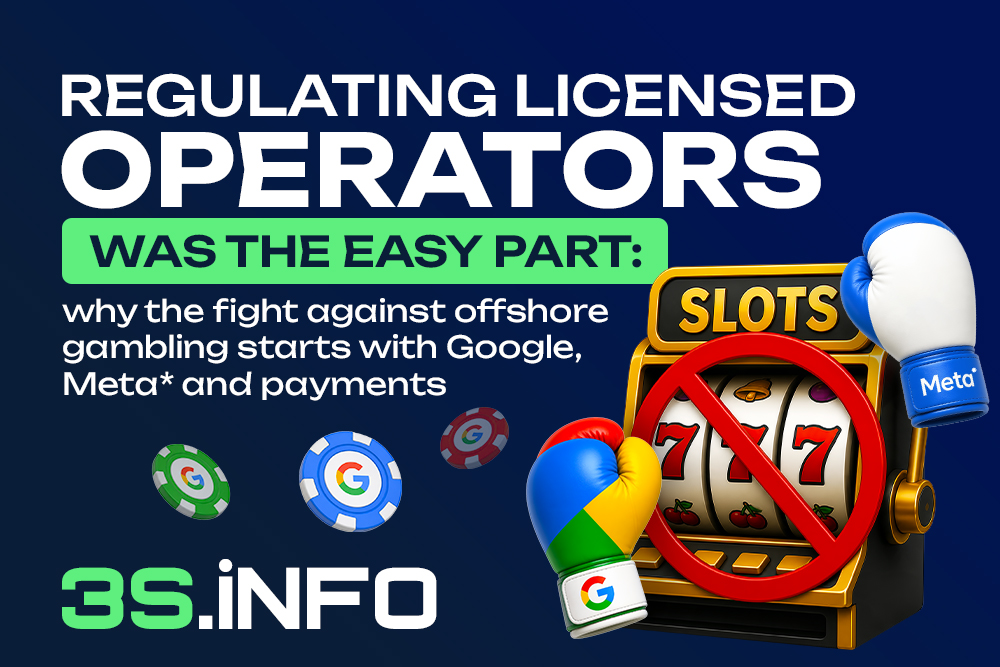
As a result, the debate in the Netherlands is shifting direction. The question is no longer just how many rules an operator must follow. Parliament is calling for scrutiny of the entire infrastructure that lets an illegal brand find and serve a Dutch player: Google, Meta*, affiliates, hosting providers, payment providers, and other technology companies. The government has confirmed that it is discussing the issue with Google and Meta*, and is also preparing a legal framework for DNS blocking of illegal sites. A consultation on the relevant changes is expected in early 2027.
This shift matters well beyond the Netherlands. It shows why a modern regulated market cannot be built on licenses and requirements for licensees alone.
On 3S.INFO, we examine why licenses, fines, and restrictions on legal operators alone are not enough to curb offshore gambling. How to build the fight against offshore across the entire funnel: from Google and Meta* to SEO affiliates, hosting providers, PSPs, and acquiring. Why the effectiveness of regulation should be measured not by the number of licenses and fines, but by real channelization by GGR, the accessibility of illegal brands, and the reduction of player harm across the entire market.
How Channelization Turned Into a Constraint on the Legal Offering
The original logic of the Dutch reform revolved around channelization, steering players away from illegal sites toward licensed operators. The term itself is fundamentally important: the state's goal is not to eliminate gambling entirely, which is practically impossible online, but to direct existing demand toward venues where the product can be controlled and consumers protected.
After the market launched, however, the political emphasis began to shift. A surge in advertising and the rapid expansion of the online segment triggered a public backlash. In July 2023, the country banned untargeted online gambling advertising on television, radio, billboards, and in print media. Restrictions on sports sponsorship were introduced in stages, and a full ban on such sponsorship took effect in July 2025.
New deposit limit rules took effect on October 1, 2024. An adult player wishing to set a monthly limit above €350 must confirm their financial standing to the operator. For players aged 18 to 24, the threshold is €150. Once these amounts are reached without additional verification, further deposits are blocked.
From a responsible gambling standpoint, the logic is clear: cap financial harm before it becomes critical. But a regulated market does not exist in a vacuum. Right next to it sits the illegal segment, where you can skip income checks, avoid explaining the size of your deposit, and never face operator intervention.
In 2026, the government proposed going further: a near-total ban on online gambling advertising and bonuses, raising the minimum age for the riskiest online products to 21, and expanding the powers to block illegal sites. For now, these are political proposals rather than a fully enacted set of rules. But the direction is clear: the legal product is becoming less visible, less flexible, and less competitive.
The key question is not whether each individual restriction is justified. The question is the cumulative effect. If licensed companies are systematically stripped of advertising, bonuses, sponsorship, high limits, and part of their audience, while the illegal sector retains access to traffic and payments, the market will not disappear. Only the distribution of players between its controlled and uncontrolled parts will change.
Most Players Stay Legal, but Not Always Most of the Money
The debate over the results of Dutch regulation is complicated by an unusual statistical picture. According to estimates from Kansspelautoriteit, the share of players using legal platforms remains high. But if channelization is measured not by headcount but by money, the outcome is considerably worse.
For 2025, licensed venues accounted for only about 53% of the combined GGR of the online market. In other words, nearly half of gross gaming revenue could be generated outside the regulated sector. Back in autumn 2025, the KSA warned that the illegal segment was becoming comparable to the legal one. In the first half of 2025, licensed operators' GGR came to around €600 million, down roughly 16% compared to the second half of 2024.
There is no contradiction here. Most ordinary users may indeed play with licensees, while a small group of active or high-value players brings offshore operators a disproportionately large share of GGR. It is precisely this audience that reacts most sharply to deposit limits, source-of-funds checks, mandatory pauses, and responsible gambling interventions.
That is why a channelization metric based on accounts can create a false sense of security. If nine out of ten players are with licensees but the largest deposits flow offshore, the system formally covers the audience while losing a significant share of the risk. The players who potentially need protection most end up exactly where there is no CRUKS, no mandatory behavior monitoring, and no guaranteed complaints procedure.
This does not mean limits should be scrapped. But when assessing their effectiveness, one cannot look only at the drop in spending inside the legal market. Part of that decline may genuinely mean people are playing less. Another part may be the result of migration that licensee statistics no longer capture.
Offshore Sells Not a Better Product, but the Absence of Rules
An illegal operator does not need a better website, superior slots, or a strong brand. Its competitive edge often lies in not meeting requirements that add cost and friction to the funnel.
Such an operator can offer a large welcome bonus, accept a high deposit without a financial check, register a player from CRUKS, impose no session limits, and use aggressive communication. It can swap domains, landing pages, and ad accounts faster than the regulator can work through administrative procedures.
This produces an awkward paradox. Every new obligation imposed on a licensee raises the cost of the legal product. If that same obligation does not effectively apply to an offshore competitor, breaking the rules turns into a commercial advantage.
This becomes especially stark once advertising is almost entirely restricted. A legal brand is barred from actively telling the audience why its platform is safer and how it differs from an illegal site. An offshore operator, by contrast, keeps promoting itself through social media, search results, influencers, Telegram channels, SEO sites, and affiliate funnels.
In such a setup, the state dims the visibility of the authorized product without necessarily reducing the overall visibility of gambling. It simply frees up advertising space for companies that have no intention of respecting the ban.
Why a Fine Against a Casino Is No Longer Enough
The KSA can investigate an illegal operator's activity and impose a hefty fine on it. In the Netherlands, not only the direct offering of gambling is considered unlicensed, but also its promotion or facilitation. The base fine for a company with turnover under €15 million can be €600,000, while for larger businesses it is calculated as a percentage of turnover.
But a regulator's decision is only effective when the violator has assets, a responsible legal entity, or some other presence in an accessible jurisdiction. An offshore casino may have a nominee company, a license in a third country, distributed technical infrastructure, and several dozen domains. The fine exists on paper, while the business keeps operating through a new mirror.
Even blocking a site solves only part of the problem. DNS blocking makes access harder for an ordinary user, but it does not destroy the product itself. An operator can register a new domain, redirect the audience, use an app, a mirror, or an alternative DNS. If ad accounts, hosting, payments, and the affiliate network remain in place, rebuilding the funnel takes less time than pursuing it legally.
That is precisely why the unit of regulation should not be a single URL, but the entire supply chain of illegal gambling:
advertising and search → affiliate or influencer → site and hosting → registration → payment → gaming account.
An offshore brand remains accessible not because the regulator is unaware of its existence. It remains accessible because, at every stage, it is served by perfectly legal infrastructure companies.
Meta* Became the Most Visible Symbol of the Problem
The most visible conflict has arisen around Facebook* and Instagram*. Holland Casino stated that it had sent Meta* more than 4,600 notifications about suspicious advertising for illegal gambling. At the same time, removing individual ads did not solve the problem: advertisers came back under different names and with new accounts.
In the summer of 2026, VNLOK, an industry association of licensed operators, announced legal action against Meta* and filed a complaint with the European Commission. The association claims that more than 95% of the gambling advertising found on Meta* platforms is tied to illegal offerings.
A separate study estimated the combined potential reach of such ads in March 2026 at roughly 37.9 million advertising contacts. This does not mean that 37.9 million different Dutch residents saw the ads, as the country's population is considerably smaller. The figure reflects the estimated number of impressions, accounting for repeated exposure of a single user to multiple ads.
What matters most in this case is the asymmetry of control. A licensed operator must confirm its right to operate in the market, comply with advertising restrictions, exclude minors and young users from targeting, and answer to the KSA. An illegal advertiser often clears automated moderation and is only removed after an external complaint.
As a result, the entire cost of compliance rests with the licensee and the regulator. The platform collects advertising revenue, while the burden of verifying legality is effectively shifted onto those who already follow the law.
Meta* is not expected to parse the finer points of every ad on its own. The Netherlands has an official register of licensees. Technically, the model could be far simpler: only a verified legal entity holding a valid license would be entitled to advertise gambling, while the domain in the ad would have to match the operator's approved domain.
This would not eliminate cloaking, page swapping, and other ways of slipping past moderation. But it would change the underlying principle from "allowed until a complaint arrives" to "prohibited until the right is confirmed."
Google's Role Goes Beyond Advertising
For Google, the problem goes beyond ad accounts. Search remains one of the main channels through which a user finds a casino after seeing a brand name on social media, from an influencer, or on a sports site.
Even if an illegal operator does not buy ads directly, it can be promoted by SEO affiliates. Queries like "casino zonder CRUKS," meaning casino without CRUKS, are commercially valuable precisely because they express a desire to bypass the national self-exclusion system. As a result, the search engine can steer a vulnerable user toward a product they had previously chosen to shut themselves out of.
Full real-time deindexing of every illegal domain is hardly feasible. But with KSA lists in hand, a search engine can move faster to remove confirmed violators, restrict the ad accounts of connected parties, and lower the visibility of pages that systematically promote unlicensed brands.
Affiliates play a special role here. The classic control model assumes that a licensee is responsible for its partners. In an offshore chain, there is no national licensee, so an affiliate may remain the only participant actually located in a European jurisdiction. Regulators will inevitably treat it less as a neutral advertising platform and more as an intermediary providing access to an illegal service.
For the legal affiliate business, this is both a risk and an opportunity. The risk lies in growing requirements to verify offers, domains, and licenses. The opportunity lies in cleaning up search results by removing competitors who earn inflated CPA and RevShare rates precisely for promoting an illegal product.
Why Payments Can Be More Effective Than Blocking a Domain
Traffic alone is not enough for an online casino to exist. It needs to accept deposits and pay out winnings. That is why payment infrastructure becomes one of the most vulnerable parts of the offshore model.
If banks, acquirers, e-wallets, and payment providers promptly cut off a confirmed illegal operator, the value of its advertising drops sharply. A new domain can be registered in minutes. Finding a stable payment route capable of handling a significant volume of transactions without creating mass withdrawal problems is far harder.
The Dutch regulator is already widening its focus from casinos themselves to the B2B companies and services that sustain illegal offerings. In the KSA's 2026 supervisory agenda, cooperation with payment companies, hosting providers, and social platforms is flagged as a separate priority.
Payment blocking, however, is not a magic button either. Operators resort to cascading acquiring, payment description spoofing, merchant laundering, P2P transfers, vouchers, and cryptocurrencies. Overly broad restrictions can sweep up legitimate transactions or push banks into blocking clients without sufficient grounds.
An effective model therefore requires not a blanket order to "stop serving gambling," but precise, regularly updated identifiers: legal entities, domains, merchant accounts, wallets, and associated payment intermediaries. It also requires an appeals procedure, so that the fight against offshore does not turn into an opaque financial ban.
Equal Rules Are Not a Favor to Legal Casinos
The position of Holland Casino and other licensees is easy to frame as an attempt to protect their own revenue. A commercial interest does indeed exist. Legal companies want competitors not to gain an advantage by skipping taxes and ignoring restrictions.
However, that does not make the argument wrong. In this case, the interests of the state and those of the licensee partially align. A player at a legal operator has access to CRUKS, deposit controls, complaints procedures, rules on safeguarding funds, and the ability to turn to the regulator. A customer of an offshore casino often lacks even a guarantee of payout.
In the Netherlands, operational restrictions are compounded by tax pressure. The gambling tax rate rose from 30.5% of GGR in 2024 to 34.2% in 2025 and 37.8% in 2026. At the same time, opportunities for advertising and bonus promotion are shrinking. This worsens the economics for licensees and raises the viability threshold for legal businesses.
If the regulated market becomes commercially unattractive, some operators may cut investment or exit. Competition will decline, and the player's choice between a strong legal brand and offshore will become less obvious. That is why the sustainability of licensees is not merely a question of industry profit. It is one of the conditions for channelization to work.
Legal iGaming: What to Measure Instead of License Counts and Fines
The number of licenses issued shows how many companies the state has allowed into the market. The number of fines shows how active the regulator is. Neither metric, on its own, answers the key question: what share of actual gambling takes place in a controlled environment?
To assess regulation, at least two channelization metrics are needed: one by player count and one by GGR. In addition, it is worth tracking the share of large deposits in the legal sector, user migration after hitting limits, the visibility of illegal brands in search and social media, the speed at which their ads are removed, the ability to top up an account through popular payment methods, and the share of CRUKS-registered players who keep playing on offshore sites.
It is also essential to assess the cumulative effect of the rules. Each restriction may look reasonable in isolation. But advertising, taxes, bonuses, limits, age thresholds, and affordability checks all act at the same time. When analyzed in isolation, it is easy to miss the moment when the regulated product starts losing to the illegal one, not on quality, but on accessibility.
The key KPI should be not the severity of the regime, but the reduction of gambling harm across the entire market. A decline in licensees' GGR does not yet equal a decline in player spending. In some cases, it points to successful prevention; in others, to a loss of visibility.
A License Regulates a Company, but the Market Is Built on Infrastructure
The Dutch case reveals the limits of an operator-centric model. The state can regulate a licensee's product, advertising, limits, and duty of care in granular detail. But if an illegal competitor keeps appearing in Google, buying impressions on Meta*, drawing traffic from affiliates, and accepting payments through European infrastructure, only the most law-abiding slice of the market is actually under control.
The next stage of regulation will be distributing responsibility across the entire chain. Social networks must verify an advertiser's right to promote gambling. Search engines must respond faster to official lists of illegal domains. Payment providers must detect servicing of unlicensed operators. Hosting providers and registrars must enforce the regulator's decisions. Affiliates must answer for knowingly steering players to illegal venues.
That said, the state will need to hold the balance. Infrastructure companies should not morph into private regulators with the power to shut down businesses via opaque algorithms. Decisions must be grounded in verifiable KSA data, come with a clear procedure, and move fast enough that a violator cannot keep swapping shells indefinitely.
The core lesson from the Netherlands is not that responsible gambling is at odds with the market. Player protection is the whole point of legalization. The trouble starts when that protection works only inside the licensed perimeter, while stepping outside it remains easy, visible, and commercially tempting.
Restricting a legal operator is admittedly easier: it has a license, an office, a bank account, and a reputation on the line. But the ease of control should not steer policy. If the regulator keeps piling demands on those already inside the system while asking almost nothing of the infrastructure that serves offshore, it does not shrink the market. It redistributes it in favor of the players hardest to control.
So the genuine fight against illegal gambling does not start with yet another ban aimed at a licensee. It starts in a Meta* ad account, in Google search results, in an affiliate link, on a hosting server, and at the moment a deposit is processed. As long as these links operate without a shared system of responsibility, a license alone is indeed not enough.
*Meta Corporation is recognized as extremist in Russia. Its services Facebook and Instagram are blocked by court decision.