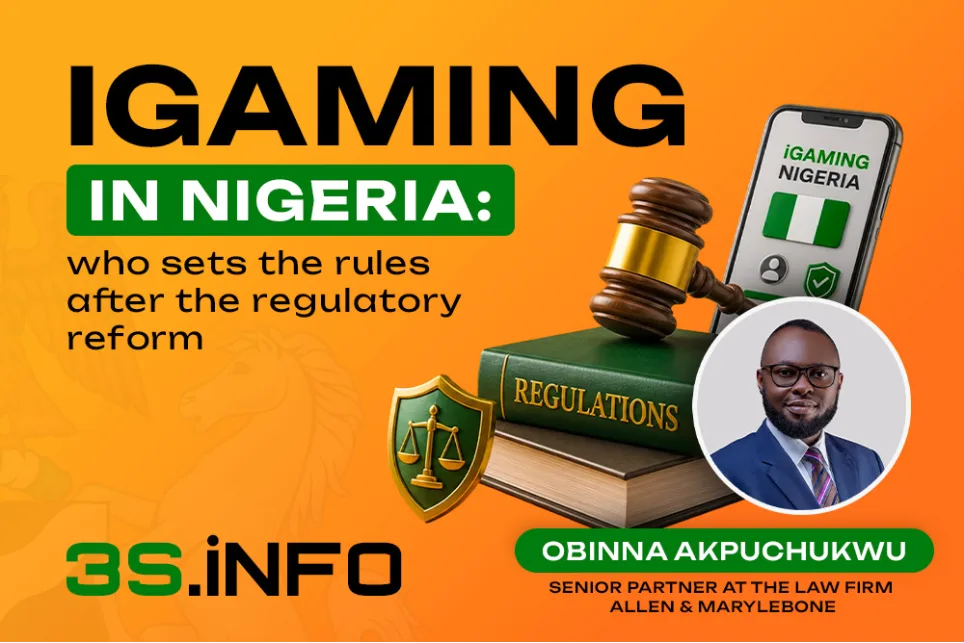
How to operate in Nigeria's iGaming market when a license from a single state does not grant the right to take players nationwide, and regulation is split between several bodies? In an interview with 3S.INFO, we break down what changed after the Supreme Court's ruling and how the universal licensing model for states is structured. Together with Obinna Akpuchukwu, Senior Partner at the law firm Allen & Marylebone, we discuss liability for affiliate advertising and traffic, local payment infrastructure, and the prospects for bringing state rules closer together.
What Changed After the Supreme Court Ruling
- Following the Nigerian Supreme Court’s November 2024 ruling, regulation shifted to the state level. How has this reform changed the day-to-day operations of operators, affiliates, and B2B providers?
This reform has changed the day-to-day operation of operators in the areas of lesser licensing fees and regulatory compliance. Prior to that decision, operators were paying for a nationwide license issued by the NLRC in addition to paying licensing fees for individual states. Apart from the licensing fees, they were made to comply with each state's licensing requirements. However, with the current universal licensing framework introduced by the Federation of State Gaming Regulators, operators now pay for and obtain one license that covers about 25 member states in Nigeria. Again, an operator may choose to operate in just one state and obtain license from only that state instead of having to pay for a national license from the NLRC even when they have no interest in operating nationally.
- 22 November 2024: a seven-judge panel of the Supreme Court unanimously ruled that the National Lottery Act 2005 should not apply in the states. The National Assembly's powers on this matter are limited to the Federal Capital Territory (FCT). Legislative regulation of lotteries and games of chance in the states was assigned by the court to the legislatures of the respective states.
- The next stage came on 7 May 2025: FSGRN members signed the Subnational Reciprocity Licensing Framework. The agreement introduced the Universal Reciprocity Certificate (URC), a mechanism for shared admission to operate in the states participating in the system. Transitioning operators with NLRC licenses were granted an exemption from licensing fees for 2025, subject to meeting FSGRN requirements. Renewal and payment of the relevant fees were to begin on 1 January 2026. This is a transitional relief, not a permanent exemption from fees.
- Want to get to grips with the subject in full? The review "How to Run Betting and Gambling Traffic in Nigeria" will be useful to a wide range of African iGaming professionals, from affiliates to operators. Operators will see their market through an affiliate's eyes, and grasp what actually drives conversion and LTV, and why solid payment solutions and local UX outweigh yet another bonus. Affiliates will get a detailed map of the market: the current regulatory situation, the reasons Nigeria is not merely one of the African GEOs but a full-fledged market with a serious economy, and ways to integrate into it in compliance with local laws and platform requirements. For anyone looking at Africa strategically, Nigeria is the centrepiece: without understanding it, it is hard to build a long-term strategy in a region where iGaming, mobile money, and a young audience are shaping new approaches to acquisition and monetization.
Who Is Responsible for Regulation, and How the Shared Model Works
- Where does the division of powers currently lie between state regulators, the Federation of State Gaming Regulators of Nigeria (FSGRN), and the NLRC, which retains its regulatory role in the Federal Capital Territory (Abuja)?
The Federation of State Gaming Regulators (FSGRN) is made up of about 25 state regulators. They reached an agreement to harmonize regulatory compliance requirements and licensing fees for operators seeking to operate in those states. They exercise the same regulatory powers within their member territory as do non-member state regulators and the NLRC in Abuja.
- According to SiGMA's description, the shared model involves filing a single application with the FSGRN secretariat, accompanied by standardized documents, compliance declarations and proof of financial standing. The URC covers online betting, online casinos, public online lotteries and promotional contests. At the same time, the agreement preserves the independent powers of the states rather than creating a new federal regulator.
- The Supreme Court ruling confirms the special status of the FCT, but does not in itself establish a comprehensive, up-to-date framework for how all agencies in Abuja operate. A June review by iGaming Business specifically mentions the FCT Lottery Regulatory Office (FCT-LRO), which issues permits for activity in the capital territory. The reference to the NLRC in this Q&A should therefore not be read as a complete guide to FCT licensing. The competent authority and the applicable procedure must be confirmed at the time of application.
- How do licensing requirements differ between Lagos, Abuja, and other key states? Can an operator consider itself “legal in Nigeria” if it holds a license in only one state?
The licensing requirements are essentially the same, apart from differences in licensing fees. An operator with a license from only one state is a legal operator to the extent that its operations are limited to just that state. Any operation outside that state is deemed an illegal operation.
- The URC applies in the states participating in the FSGRN agreement, not automatically across the whole of Nigeria. It is precisely this territorial coverage that sets the instrument apart from what is presumed to be a nationwide license. A single procedure does not override the boundaries of participation in the system.
Why the Dispute Over the Central Gaming Bill Arose
- How could the ongoing dispute between Lagos and the National Assembly change the regulatory landscape in 2026?
The contempt proceedings have been discontinued after President Tinubu declined to sign the Central Gaming Bill into law. Recall that the contempt proceedings was initiated as a result of the National Assembly's move to enact the law despite the Supreme Court's decision.
- In October 2025, Lagos authorities came out against the Central Gaming Bill, which envisaged nationwide regulation of online and remote gaming. The state's Attorney General, Lawal Pedro, said the initiative contradicted the Supreme Court's 2024 ruling and urged the Senate not to support it. At that point, the bill had already passed the House of Representatives.
- On 10 November 2025, THISDAY reported that Lagos had asked the Supreme Court for permission to begin enforcement proceedings by issuing Form 48, a procedural warning that precedes further action on contempt of court. This report does not establish that the National Assembly had already been found guilty of such a violation.
- President Tinubu's refusal to sign the Central Gaming Bill is discussed in an opinion piece by Bashir A. Are published by THISDAY on 26 January 2026. The report is also posted in the January archive on the official website of the Lagos State Lotteries and Gaming Authority. Note that 26 January is the date the article was published, not the date of the presidential refusal as established by these materials.
Local Entity and Naira Payments
- How are international operators regulated? Are they required to establish a local legal entity, appoint a representative in Nigeria, or maintain servers and/or payment infrastructure within the country?
International Operators are required to register and set up a local legal entity in Nigeria (limited liability company) through which they would operate within Nigeria. They would also be expected to set up Naira payment architecture which they can achieve through collaboration with local payment service providers.
- The description of the URC procedure states that the applicant must submit a standardized set of documents, compliance declarations and proof of financial standing. The shared model therefore involves a separate review of each operator rather than automatic recognition of any foreign license.
Who Is Liable for Affiliate Advertising and Traffic
- Who is liable if an affiliate uses misleading advertising, promises guaranteed winnings, or directs traffic to an operator that does not hold the required license in a particular state?
The operator may be held vicariously liable in any of the three scenarios painted, especially where the operator did not take immediate steps to retract the misleading advertisements or promises of guaranteed winnings. In the same vein, the operator may be sanctioned by a regulator where the affiliate marketer directs traffic to an operator that does not hold the required license in the particular state. This is especially where the operator accepts bets from punters in those states where they have no license to operate.
- The territorial principle is also reflected in the design of the URC: the certificate covers only the states participating in the agreement. iGaming Business specifically stresses that the shared model is not binding on states outside it. An operator's admission in one part of the country therefore cannot be automatically extended to audiences in other territories.
Harmonization or Further Fragmentation?
- What will the Nigerian iGaming market look like over the next two to three years? Is it moving toward genuine regulatory harmonization between states, or toward even greater fragmentation in licensing, taxation, and advertising requirements?
I believe the iGaming market is moving towards genuine regulatory harmonization. I expect more non-member states to join the Federation of State Gaming Regulators (FSGRN) in the coming years. At the moment, the FSGRN has about 25 members out of the 36 states in Nigeria (37, if you include Abuja the Federal Capital Territory).
- The launch of the URC in May 2025 confirms the shift toward a shared licensing procedure. However, an iGaming Business review dated 4 June 2026 refers to roughly 22 states in the association, whereas the interviewee cites around 25. Without an up-to-date official list of members, it is impossible to establish with confidence the reason for the discrepancy or to confirm the exact number as of the date the interview was published.
- For now, harmonization does not entail the disappearance of individual territorial regimes. According to estimates by lawyers cited in iGaming Business, the mutual recognition mechanism simplifies the work of online operators, but does not replace state legislation and does not remove the need to verify admission in each specific jurisdiction.
- Nigeria consists of 36 states and the Federal Capital Territory. The reference to the FCT as an additional territory in the answer does not mean that it is a 37th state or that it automatically falls within the URC system.
What This Means for Operators and Affiliates
According to Obinna Akpuchukwu, entering the market requires not only paperwork but also a local entity, naira payment infrastructure and oversight of affiliate advertising. At the same time, the confirmed timeline of the reform shows that the Supreme Court ruling and the launch of the URC are related but distinct events. The first cemented the powers of the states, while the second created a mechanism for cooperation among FSGRN members.
Expanding this system may simplify operations across several states, but it does not turn local admission into an unconditional right to take players throughout Nigeria. For businesses, it is essential to understand which territories a permit covers and which requirements continue to apply outside the shared model.
Are you an expert in your field and ready to help develop the iGaming market? Get in touch! We will prepare the questions.